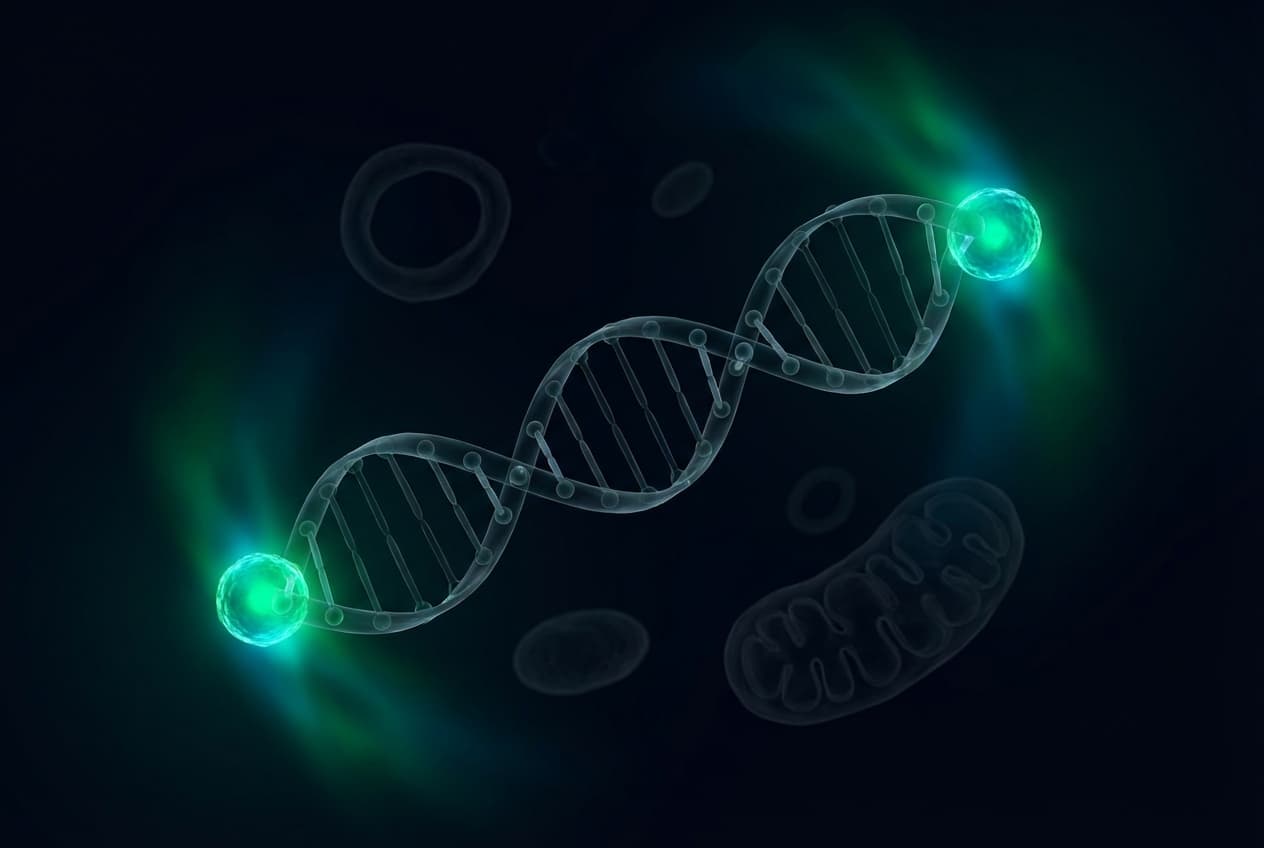
NAD+ in Cellular Biology
Nicotinamide adenine dinucleotide (NAD+) is one of the most essential molecules in biology. Present in every living cell, this coenzyme participates in more than 500 enzymatic reactions and serves dual roles as a metabolic cofactor in energy production and as a substrate for signaling enzymes that regulate DNA repair, gene expression, stress responses, and circadian rhythms. The molecule exists in oxidized (NAD+) and reduced (NADH) forms, shuttling electrons in catabolic reactions including glycolysis, the citric acid cycle, and mitochondrial oxidative phosphorylation — the processes that generate the vast majority of cellular ATP.
Beyond its metabolic cofactor role, NAD+ serves as a consumable substrate for three critical enzyme families: sirtuins (NAD+-dependent protein deacetylases/deacylases), poly(ADP-ribose) polymerases (PARPs, which catalyze DNA repair), and cyclic ADP-ribose synthases (including CD38 and CD157). These enzymes do not merely use NAD+ as a cofactor — they cleave it, consuming the molecule and necessitating continuous biosynthesis to maintain cellular pools.
The Age-Related NAD+ Decline
One of the most consistent findings in aging biology is the progressive decline of NAD+ levels with age. Studies across multiple species and tissues have demonstrated that NAD+ concentrations in aged tissues are typically 40–60% lower than in young tissues. This decline is driven by multiple converging mechanisms.
Increased consumption by CD38. CD38 is a transmembrane glycoprotein and the dominant NAD+ consumer in most mammalian tissues. Its expression increases with age, driven in part by chronic low-grade inflammation (inflammaging) and accumulation of senescent cells. CD38 has an extremely low catalytic efficiency for its signaling product (cyclic ADP-ribose) but high NADase activity, meaning it degrades far more NAD+ than is needed for its signaling function. Age-related increases in CD38 expression are now considered the single largest driver of NAD+ decline in most tissues.
Chronic PARP activation. As DNA damage accumulates with age from oxidative stress, replication errors, and environmental exposures, PARP1 and PARP2 are chronically activated to repair the damage. Each DNA repair event consumes multiple NAD+ molecules. In aged cells with high levels of ongoing DNA damage, PARP activity can consume NAD+ faster than it can be replenished, creating a competition with sirtuins for the available NAD+ pool.
Decreased biosynthesis. The expression and activity of nicotinamide phosphoribosyltransferase (NAMPT), the rate-limiting enzyme in the NAD+ salvage pathway, declines with age in multiple tissues. Since the salvage pathway (recycling nicotinamide back to NAD+) is the dominant biosynthetic route in most mammalian cells, reduced NAMPT activity directly impairs NAD+ production capacity.
Altered salvage pathway efficiency. Beyond NAMPT decline, other salvage pathway enzymes show reduced expression with age, and the availability of precursor substrates may become limiting in certain tissues.
The consequences of NAD+ decline are far-reaching: impaired mitochondrial function (reduced electron transport chain activity, increased reactive oxygen species production), reduced sirtuin activity (compromising metabolic regulation, stress resistance, and DNA repair), compromised PARP-mediated DNA repair (creating a vicious cycle of DNA damage accumulation), and disrupted circadian rhythm regulation.
NAD+ and the Sirtuin Family
Sirtuins (SIRT1–SIRT7 in mammals) are NAD+-dependent protein deacetylases and deacylases that regulate a vast array of cellular processes. Their absolute requirement for NAD+ as a co-substrate makes their activity directly sensitive to cellular NAD+ levels — as NAD+ declines with age, sirtuin activity decreases proportionally.
SIRT1 is the most extensively studied sirtuin. It resides primarily in the nucleus and cytoplasm, where it deacetylates key transcriptional regulators including PGC-1alpha (the master regulator of mitochondrial biogenesis), FOXO transcription factors (stress resistance and autophagy), NF-kB p65 subunit (inflammation), and p53 (apoptosis and senescence). Through these substrates, SIRT1 coordinates glucose homeostasis, lipid metabolism, mitochondrial function, inflammation, and cellular stress responses. SIRT1 activity enhancement through NAD+ supplementation has been shown to improve metabolic parameters in multiple preclinical models.
SIRT3 is the primary mitochondrial sirtuin, located in the mitochondrial matrix where it deacetylates enzymes involved in fatty acid oxidation, the citric acid cycle, and the electron transport chain. SIRT3 also activates mitochondrial superoxide dismutase 2 (SOD2) through deacetylation, directly enhancing mitochondrial antioxidant defense. Reduced SIRT3 activity in aged tissues contributes to mitochondrial dysfunction and increased oxidative damage.
SIRT6 plays a critical role in genomic stability. It localizes to sites of DNA double-strand breaks and facilitates repair through recruitment of repair factors and chromatin remodeling. SIRT6 also maintains telomere integrity by deacetylating histone H3K9 at telomeric chromatin, preventing telomere dysfunction and cellular senescence. SIRT6 knockout mice show dramatically accelerated aging phenotypes, while SIRT6 overexpression extends lifespan in male mice.
Other sirtuins include SIRT2 (cytoplasmic, regulates cell cycle and myelination), SIRT4 (mitochondrial, regulates glutamine metabolism and insulin secretion), SIRT5 (mitochondrial, regulates succinylation and malonylation), and SIRT7 (nucleolar, regulates ribosomal DNA transcription and the integrated stress response).
PARP Enzymes and DNA Repair
PARP1 is one of the most abundant nuclear proteins and serves as a first responder to DNA damage. Upon detecting single-strand breaks, PARP1 binds to the damaged site and catalyzes the addition of poly(ADP-ribose) chains to itself and nearby histones, using NAD+ as the ADP-ribose donor. These chains recruit DNA repair machinery and relax local chromatin structure to facilitate repair access.
Each ADP-ribose unit added requires one NAD+ molecule, and PARP1 can add chains of 200+ units per activation event. In young cells with low levels of DNA damage, PARP activity is modest and NAD+ consumption is easily matched by biosynthesis. However, aging increases the steady-state level of DNA damage through accumulation of oxidative lesions, replication errors, and impaired repair efficiency. The resulting chronic PARP activation creates a metabolic conflict: PARP and sirtuins compete for the same declining NAD+ pool. When PARP consumption dominates, sirtuin activity is compromised, reducing the cell's capacity for metabolic regulation, stress resistance, and — paradoxically — additional DNA repair through sirtuin-dependent mechanisms.
4 compounds bundled · Save 15%
NAD+ Restoration Approaches
Direct NAD+ supplementation provides the coenzyme itself, bypassing all biosynthetic steps. MiPeptidos offers NAD+ as lyophilized powder at 99%+ purity for research applications. Direct NAD+ has the advantage of immediate availability without requiring enzymatic conversion, though its cellular uptake mechanisms and tissue distribution after systemic administration are areas of active investigation.
Precursor supplementation with nicotinamide riboside (NR) or nicotinamide mononucleotide (NMN) supplies intermediate metabolites that enter the salvage pathway and are enzymatically converted to NAD+. NR is converted to NMN by nicotinamide riboside kinases (NRK1/NRK2), and NMN is converted to NAD+ by nicotinamide mononucleotide adenylyltransferases (NMNAT1–3). These precursors have demonstrated effective NAD+ repletion in multiple tissues in preclinical studies.
CD38 inhibition represents a complementary strategy that reduces NAD+ consumption rather than increasing supply. By inhibiting the dominant NAD+ consumer, CD38 inhibitors can preserve existing NAD+ pools and enhance the effectiveness of supplementation strategies.
Preclinical Research Results
NAD+ restoration through various approaches has produced impressive results in preclinical models. Improved mitochondrial function, including increased oxygen consumption rates, enhanced membrane potential, and reduced ROS production in aged mitochondria. Enhanced insulin sensitivity and glucose tolerance in aged and diet-induced obese rodent models. Improved vascular function, including enhanced endothelium-dependent vasodilation and reduced arterial stiffness. Extended healthspan metrics including improved physical performance, cognitive function, and resistance to metabolic stress. Extended lifespan in some model organisms, though results vary by species, strain, and supplementation protocol.
Practical Research Notes
NAD+ is available from MiPeptidos as lyophilized powder at 99%+ purity. Store at -20°C protected from light and moisture. NAD+ is light-sensitive and hygroscopic. Reconstitute with bacteriostatic water; use within 30 days when stored at 2–8°C. Prepare aliquots to avoid repeated freeze-thaw cycles.
Disclaimer
For educational purposes only. Not for human consumption.