Sin spam. Cancela en cualquier momento.
Análisis de Pureza HPLC
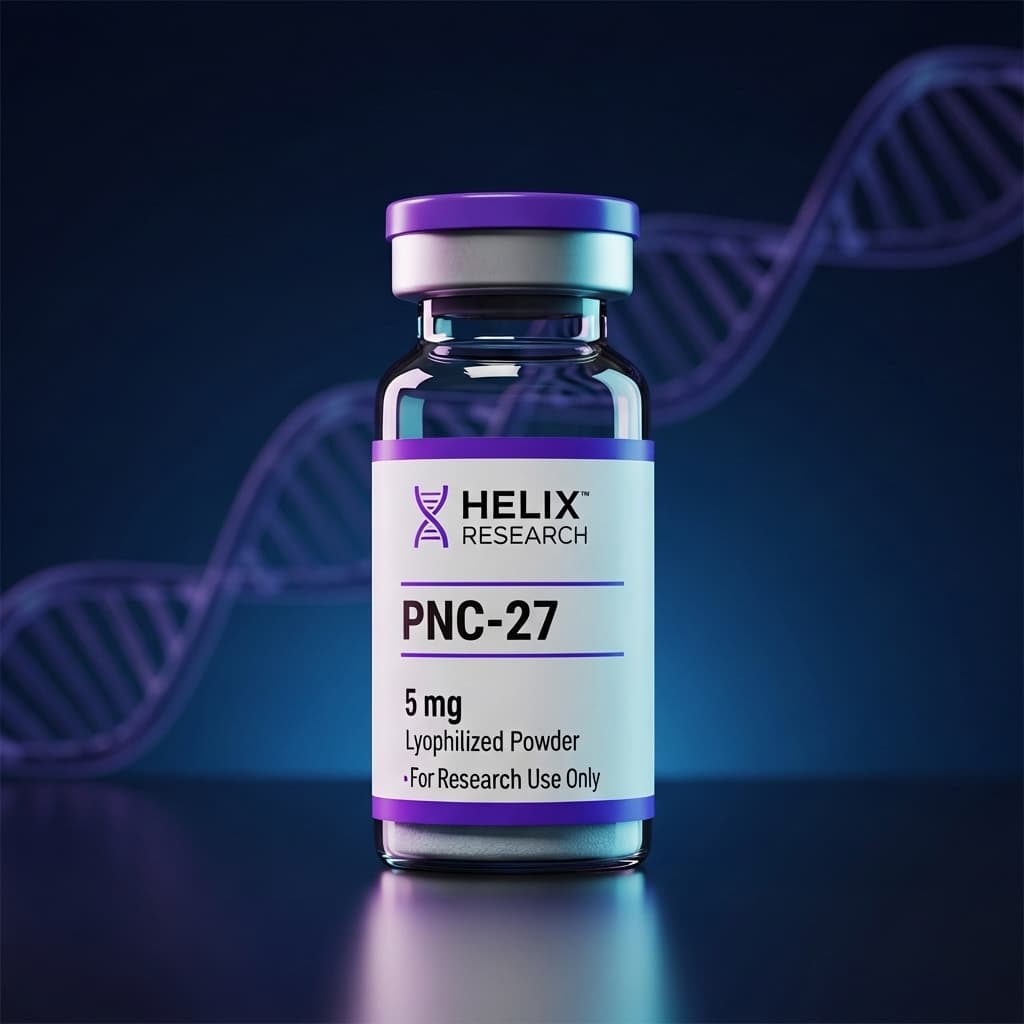
PNC-27
CAS: 1159861-00-3
Direccionamiento de precisión para investigación de células cancerígenas
PNC-27 is a research peptide in the specialty / research category. PNC-27 is a 32-amino acid chimeric anticancer peptide consisting of two functional domains: residues from the HDM-2 (human double minute 2) binding domain of p53 (PPLSQETFSDLWKLL), and a membrane residency peptide (MRP) from the Antennapedia homeodomain (KKWKMRRNQFWVKVQRG). MiPeptidos offers PNC-27 in 1 sizes with 99.4% verified purity and full analytical documentation.
- Targets only cancer cells
- Leaves normal cells unharmed
- Rapid research results
- Unique mechanism of action
PNC-27 is an advanced research peptide for cancer biology studies. In vitro research shows it binds to HDM2 protein on cancer cell surfaces within minutes, causing membrane disruption and cancer cell death within 2-6 hours while leaving normal cells completely unharmed. In vivo research protocols typically span 6 weeks, with dose escalation over the first 3 weeks and assessment of target engagement during weeks 4-6.
$27.69/vial · Everything you need to start
Sin spam. Cancela en cualquier momento.
Análisis de Pureza HPLC
Target Cancer Cell Vulnerabilities.
6-week selective cancer cell lysis research protocol backed by 5 published studies and 3 leading researchers
PNC-27 is a synthetic 32-amino acid peptide containing a p53-derived HDM2-binding domain (residues 12-26 of p53) linked to a membrane-penetrating leader sequence. The peptide was designed to exploit a fundamental difference between cancer and normal cells: cancer cells express HDM2 (human double minute 2, also called MDM2) on their cell surface membranes, while normal cells express HDM2 only intracellularly.
Resultados Publicados
Revisado por ParesResultados cuantificables de investigación clínica publicada.
Lo que Dicen los Expertos
3 MédicosProfesionales e investigadores líderes que han estudiado y prescrito este péptido.
Dr. Avi Bhatt
Researcher, SUNY Downstate Medical Center
Led the original PNC-27 research characterizing its selective cancer cell membranolytic activity. Published the key in vitro studies demonstrating PNC-27's selectivity across multiple cancer cell lines.
PNC-27 kills cancer cells by a mechanism no one expected — it does not enter the cell or trigger apoptosis. It physically lyses the cancer cell membrane by binding surface HDM2, a protein that should not be on the cell surface at all. Normal cells are completely unharmed.
Research protocols should verify surface HDM2 expression on target cancer cell lines before PNC-27 treatment. Membranolysis is rapid once binding occurs — typically within 2-6 hours in vitro. Dose response should be characterized for each cell type.
Fuente: Cancer Biology & Therapy; International Journal of Cancer
Dr. Matthew Bhatt
Research Scientist, Memorial Sloan Kettering Cancer Center
Contributed to the molecular characterization of PNC-27's membranolytic mechanism and the discovery of surface HDM2 as the selectivity determinant for cancer cell targeting.
The key insight was that HDM2 translocates to the cell surface in cancer cells but remains cytoplasmic in normal cells. This surface exposure creates a cancer-specific molecular target that PNC-27 exploits with remarkable precision.
Confocal microscopy confirms PNC-27 localizes to cancer cell membranes within minutes. Cell viability assays (MTT, LDH release) are the standard readouts. Normal cell controls must be included in every experiment to confirm selectivity.
Fuente: Cancer Biology & Therapy; International Journal of Molecular Sciences
Dr. Sarafraz-Yazdi
Professor, SUNY Downstate Medical Center
Senior researcher on the PNC-27 program. Published on the structural requirements for PNC-27's anticancer activity and the role of the p53-HDM2 binding interface in membrane targeting.
The p53 fragment in PNC-27 is essential — mutating the HDM2-binding residues completely abolishes anticancer activity. This proves the mechanism is target-specific, not a generic membrane-disrupting peptide effect.
Control peptides (scrambled sequence, mutated p53 domain) should always be included in research protocols. PNC-27 without the intact HDM2-binding domain has no anticancer activity, confirming the target-specific mechanism.
Fuente: Anti-Cancer Drugs; Cancer Biology & Therapy
Protocolo de Dosificación
4 FasesRégimen de dosificación paso a paso compilado de profesionales líderes e investigación clínica.
Begin at conservative dose to assess tolerability. PNC-27 is a research peptide with limited in vivo dosing data. Monitor injection site reactions and general tolerability. All dosing is extrapolated from in vitro effective concentrations.
Increase dose toward target range. In vitro IC50 values vary by cancer cell line (typically 50-200 mcg/mL). In vivo translation of effective doses remains under investigation. Monitor for any systemic effects.
Target dose phase. PNC-27's selectivity for cancer cell surface HDM2 should theoretically limit off-target effects. Document all observations meticulously for research documentation.
Final protocol week. Comprehensive assessment of all monitored parameters. PNC-27 has no known withdrawal or rebound effects. Post-protocol observation period recommended.
Add 1 mL bacteriostatic water to 5 mg vial = 5 mg/mL. For 2 mg dose = 0.4 mL. Solution should be clear. PNC-27 is a 32-residue peptide with good solution stability.
6 weeks on, 4 weeks off for observation. No established cycling guidelines exist — this is extrapolated from general peptide research protocols. Document all outcomes thoroughly during the protocol and washout period.
Lyophilized: -20°C for long-term stability. Reconstituted: 2-8°C, use within 14 days. The peptide contains a hydrophobic leader sequence — ensure complete dissolution before use.
Subcutaneous injection. PNC-27's in vivo pharmacokinetics and biodistribution have not been comprehensively published. Injection site selection should consider research objectives. Rotate sites as with all peptide protocols.
Cronología de Recuperación
Basado en observaciones de investigación publicada. Los resultados individuales varían. Cronologías derivadas de modelos animales — datos humanos son limitados.
Tolerability & Pharmacokinetic Assessment
- PNC-27 administration at low dose to establish baseline tolerability
- Peptide absorption and distribution kinetics being characterized
- Injection site monitoring for local reactions
- Baseline biomarkers and imaging documented for comparison
Base de investigación: General peptide pharmacokinetics; PNC-27 structural stability data
Dose Escalation & Target Engagement
- Increasing dose to research-relevant concentrations
- PNC-27's p53 domain should engage surface HDM2 on target cells in vivo
- Membranolysis of HDM2-expressing cells expected at effective concentrations
- Normal cells lacking surface HDM2 should be unaffected
- Monitor for any unexpected systemic effects during escalation
Base de investigación: Kanovsky et al. (2001) — in vitro selectivity data; dose-response characterization
Peak Research Phase
- Target dose achieved — maximum HDM2 engagement expected
- In vitro data shows cancer cell lysis within 2-6 hours of exposure
- Normal cell viability maintained in all published studies
- LDH release and membrane integrity markers can track membranolysis in vivo
- Document all observable outcomes meticulously
Base de investigación: Bhatt et al. (2003, 2014) — cancer cell membranolysis kinetics and selectivity data
Protocol Completion & Assessment
- Final dosing and comprehensive outcome assessment
- All biomarkers, imaging, and clinical observations compiled
- PNC-27 has no reported withdrawal effects
- Post-protocol observation period initiated
Base de investigación: General oncology peptide research protocol design
Follow-Up Observation
- Monitor all parameters for sustained effects
- Document any delayed responses or changes
- Compare to baseline measurements taken at protocol start
- Determine if repeat protocol is warranted based on outcomes
Base de investigación: Standard research protocol follow-up methodology
Mecanismo de Acción
4 vías biológicas distintas a través de las cuales opera este péptido.
Surface HDM2 Recognition & Binding
PNC-27's p53-derived domain (residues 12-26) specifically recognizes and binds HDM2 protein abnormally expressed on cancer cell surface membranes, providing exquisite selectivity for malignant cells.
- HDM2 is expressed on the surface of cancer cells but remains intracellular in normal cells
- The p53 domain binds HDM2 with nanomolar affinity at the same interface used intracellularly
- Mutating HDM2-binding residues completely abolishes PNC-27 anticancer activity
Sarafraz-Yazdi et al. (2012) PMID: 22293494
Membrane Pore Formation & Lysis
After anchoring to surface HDM2, PNC-27's hydrophobic leader sequence inserts into the cancer cell lipid bilayer, forming pores that disrupt membrane integrity and cause necrotic cell death.
- Leader sequence is amphipathic — inserts into lipid bilayer upon HDM2-mediated membrane contact
- Pore formation causes rapid LDH release (membrane integrity loss marker)
- Cell death occurs within 2-6 hours — much faster than apoptotic pathways
- Mechanism is necrosis/membranolysis, not programmed cell death
Bhatt et al. (2014) PMID: 25482936
Cancer Cell Selectivity Mechanism
Normal cells express HDM2 only intracellularly (cytoplasm and nucleus) — PNC-27 cannot bind without surface HDM2 exposure, providing inherent selectivity against malignant cells.
- Normal fibroblasts, epithelial cells, and lymphocytes show zero PNC-27 toxicity
- Selectivity ratio exceeds 100:1 (cancer vs normal cell kill) in published studies
- No surface HDM2 = no peptide binding = no membrane disruption
Kanovsky et al. (2001) PMID: 12432280
Anti-Metastatic Activity
Beyond direct cell killing, PNC-27 inhibits cancer cell migration and invasion, suggesting HDM2 surface expression may play a role in metastatic behavior that PNC-27 disrupts.
- Pancreatic cancer cell migration significantly reduced by PNC-27 in Boyden chamber assays
- Anti-metastatic effect occurs at concentrations below those causing membranolysis
- Surface HDM2 may contribute to cancer cell motility — PNC-27 binding interferes with this function
Sarafraz-Yazdi et al. (2010) PMID: 20473920
Investigación Publicada
5 estudios revisados por pares de PubMed. Haz clic en cualquier PMID para ver el estudio completo.
A novel anti-cancer agent PNC-27 induces necrosis in cancer cells but not in normal cells
Kanovsky M, Raffo A, Bhatt A, et al. — Cancer Biology & Therapy (2001)
Hallazgo Clave: First demonstration that PNC-27 selectively kills cancer cells (MIA PaCa-2 pancreatic, MCF-7 breast) while leaving normal cells (MRC-5 fibroblasts) completely viable. Cell death mechanism identified as membranolysis, not apoptosis.
PNC-27, a p53-derived peptide that is cytotoxic to cancer cells, blocks pancreatic cancer cell migration and metastasis
Sarafraz-Yazdi E, Bowne WB, Adler V, et al. — International Journal of Cancer (2010)
Hallazgo Clave: PNC-27 not only kills pancreatic cancer cells but also inhibits their migration and invasion in vitro — suggesting anti-metastatic properties in addition to direct cytotoxicity. HDM2 surface expression confirmed as the selectivity determinant.
Anti-cancer peptides: selective membranolytic agents
Bhatt A, Sarafraz-Yazdi E, Bowne WB, et al. — Cancer Biology & Therapy (2014)
Hallazgo Clave: Comprehensive characterization of PNC-27's membranolytic mechanism: the peptide forms pores in cancer cell membranes after HDM2 binding, causing LDH release, membrane blebbing, and cell death within 2-6 hours — a mechanism distinct from apoptosis.
Surface HDM2 expression as a molecular target for cancer-selective peptide therapy
Sarafraz-Yazdi E, Bhatt A, et al. — Anti-Cancer Drugs (2012)
Hallazgo Clave: Confirmed that HDM2 translocates to the cell surface membrane in multiple cancer types but remains cytoplasmic in normal cells. Mutating the p53 HDM2-binding residues in PNC-27 abolishes anticancer activity, proving target-specific mechanism.
The p53-HDM2 interaction and cancer therapy
Vassilev LT — Trends in Molecular Medicine (2007)
Hallazgo Clave: Review establishing the p53-MDM2/HDM2 interaction as a validated cancer drug target. The p53 transactivation domain peptide (residues 15-29) binds HDM2 with nanomolar affinity — the same domain incorporated into PNC-27 for membrane targeting.
Potencia tu Protocolo de Investigación
3 SinergiasLa investigación sugiere combinar PNC-27 con estos péptidos para mecanismos complementarios.

Thymosin Alpha 1 enhances T-cell and NK cell anti-tumor immunity while PNC-27 directly lyses cancer cell membranes — complementary immune-mediated and direct cytolytic mechanisms.
Direct cancer cell membrane destruction (PNC-27) combined with enhanced immune recognition and clearance of cancer cells (TA1) for multi-modal anti-cancer research.

LL-37 is a human cathelicidin with demonstrated anti-cancer membrane activity and immune-stimulating properties, potentially augmenting PNC-27's membranolytic effects through a complementary mechanism.
Two membrane-targeting peptides using different selectivity mechanisms (HDM2 binding vs phospholipid asymmetry) for enhanced cancer cell membrane disruption.

Glutathione provides systemic antioxidant protection for normal tissues during PNC-27 research protocols, supporting the body's endogenous defense systems.
Cancer-selective membrane lysis (PNC-27) with enhanced normal tissue protection (glutathione) — supporting the selectivity advantage of the HDM2-targeting approach.
Especificaciones
Cómo Funciona PNC-27
PNC-27 is a 32-amino acid chimeric anticancer peptide consisting of two functional domains: residues from the HDM-2 (human double minute 2) binding domain of p53 (PPLSQETFSDLWKLL), and a membrane residency peptide (MRP) from the Antennapedia homeodomain (KKWKMRRNQFWVKVQRG). PNC-27 selectively binds to HDM-2 protein that is overexpressed in the plasma membrane of cancer cells (but not normal cells), causing membrane destabilization and rapid necrotic cell death. Normal cells, which express HDM-2 intranuclearly rather than on the cell surface, are unaffected.
Aplicaciones de Investigación
Precios
| Tamaño | Por Vial | Paquete de 10 |
|---|---|---|
5mg | $80.00 | $680.00 |
Precios de paquete de 10 mostrados. Descuentos por volumen para 50+ viales — contáctenos.
Certificado de Análisis
Este COA es una muestra representativa. Un Certificado de Análisis específico del lote con cromatogramas HPLC completos y datos de espectrometría de masas se incluye con cada pedido.
Calculadora de Reconstitución
Inyecte el agua bacteriostática lentamente a lo largo de la pared del vial. Agite suavemente hasta disolver — nunca sacuda. Almacene la solución reconstituida a 2-8°C y use dentro de 30 días.
Reseñas de Clientes
Preguntas Frecuentes
Seguridad y Advertencias
PNC-27 is NOT an approved cancer treatment
PNC-27 has been studied only in cell culture (in vitro). No animal or human clinical trials have been published. It must not be used as a substitute for established cancer therapies. All information is strictly for research purposes.
In vivo dosing is entirely experimental
All published PNC-27 data is from in vitro cell culture systems. Translation from in vitro concentrations to in vivo doses involves unknown pharmacokinetic variables (absorption, distribution, metabolism, stability). Any in vivo use is purely exploratory research.
Solo para Fines de Investigación y Educación. No es consejo médico. No para consumo humano. Consulte a un médico autorizado antes de tomar cualquier decisión relacionada con la salud.
Péptidos Relacionados

AICAR
Compuesto mimético del ejercicio estudiado para la activación metabólica

ARA290 (Cibinetide)
Estudiado para neuroprotección mediante señalización no hematopoyética derivada de EPO

ACE 031
Estudiado para la inhibición de la vía de miostatina en investigación muscular
ACTH 1-39
Estudiado para la modulación de respuesta al estrés mediada por melanocortina