Sin spam. Cancela en cualquier momento.
Análisis de Pureza HPLC
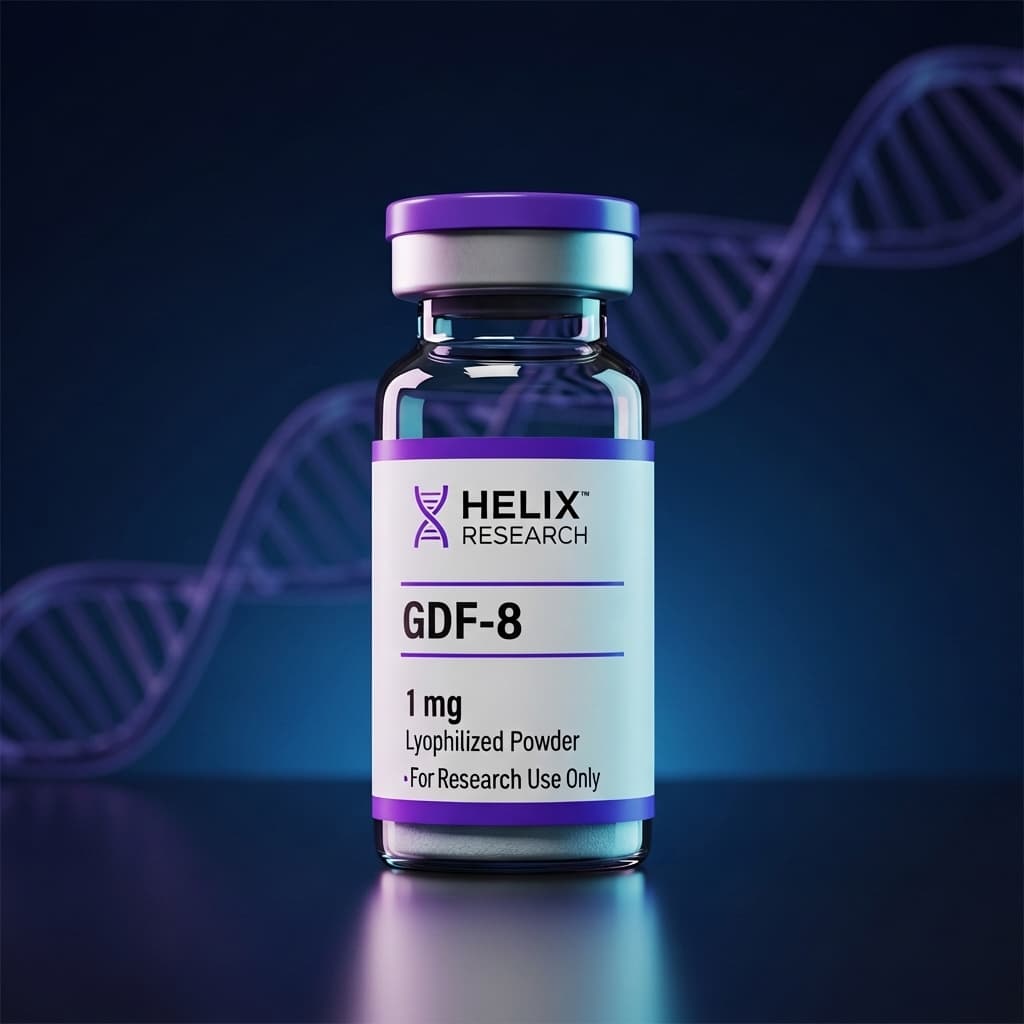
GDF-8
CAS: Not formally assigned for recombinant research peptide
Estudiado para investigación del eje miostatina-folistatina
GDF-8 is a research peptide in the specialty / research category. Myostatin (GDF-8) is a secreted TGF-beta superfamily member that serves as the principal negative regulator of skeletal muscle mass. MiPeptidos offers GDF-8 in 1 sizes with 99.5% verified purity and full analytical documentation.
- Advanced muscle research
- Inhibitor screening tool
- Signaling pathway study
- Precise assay calibration
GDF-8 (myostatin) is a specialized research reagent, not a performance compound. It is the protein that naturally limits muscle growth. Researchers use recombinant GDF-8 to study how muscle growth is regulated, to test myostatin inhibitors like FST-344 and ACE-031, and to build dose-response curves for drug development assays. Results are measured in lab outcomes, not physical changes.
$63.49/vial · Everything you need to start
Sin spam. Cancela en cualquier momento.
Análisis de Pureza HPLC
Understand Muscle Limits.
Research-grade myostatin for muscle biology studies, inhibitor screening, and signaling pathway investigation
GDF-8 (Growth Differentiation Factor 8), commonly known as myostatin, is a member of the TGF-β superfamily that serves as the primary negative regulator of skeletal muscle mass. Discovered by Se-Jin Lee at Johns Hopkins in 1997, myostatin normally acts to limit muscle growth — animals and humans with natural myostatin mutations exhibit extraordinary muscular development.
Resultados Publicados
Revisado por ParesResultados cuantificables de investigación clínica publicada.
Lo que Dicen los Expertos
2 MédicosProfesionales e investigadores líderes que han estudiado y prescrito este péptido.
Dr. Se-Jin Lee
Professor of Genetics, Johns Hopkins/Jackson Laboratory
Discoverer of myostatin (GDF-8). Foundational work establishing the myostatin-follistatin axis as the master regulator of muscle mass.
Myostatin is the key that locks muscle growth. Understanding its structure and signaling is essential for developing therapies that unlock muscle potential in patients with muscle wasting diseases.
For in vitro studies, use 10-100 ng/mL to activate ActRIIB/Smad2/3 signaling. For in vivo research, 5-10 μg/day subcutaneous demonstrates dose-dependent effects. Store reconstituted aliquots at -80°C.
Fuente: Nature (1997); PNAS (2001)
Dr. Kathryn Wagner
Professor of Neurology and Neuroscience, Johns Hopkins
Leading researcher in myostatin biology and therapeutic myostatin inhibition for muscular dystrophies.
Having high-quality recombinant myostatin is essential for screening potential therapeutic inhibitors. Every drug development program targeting the myostatin pathway needs reliable GDF-8 for its binding and bioactivity assays.
For inhibitor screening assays, use myostatin-induced CAGA-luciferase reporter in A204 or HEK293 cells. Ensure lot-to-lot consistency by testing biological activity against a reference standard.
Fuente: Neurology (2008); Muscle & Nerve (2020)
Protocolo de Dosificación
3 FasesRégimen de dosificación paso a paso compilado de profesionales líderes e investigación clínica.
Standard range for activating Smad2/3 signaling in C2C12 myoblasts, A204 rhabdomyosarcoma cells, or HEK293-CAGA reporter lines.
For dose-response muscle atrophy studies. Monitor body weight and muscle mass changes. Reconstitute in bacteriostatic water and inject subcutaneously.
For dose-response curves in inhibitor screening, follistatin binding assays, or receptor binding studies.
Reconstitute 1mg in 1mL sterile water or PBS (pH 7.4) with 0.1% BSA carrier protein. For cell culture, sterile filter through 0.22μm membrane. Aliquot immediately to avoid repeated freeze-thaw.
Not applicable — GDF-8 is used as a research tool, not a therapeutic agent. Use according to experimental design requirements.
Lyophilized: stable at -20°C for 12+ months. Reconstituted: aliquot and store at -80°C. Avoid repeated freeze-thaw. Working aliquots at 4°C stable for 1 week.
For cell culture: add directly to media. For subcutaneous research use: reconstitute in bacteriostatic water, inject subcutaneously in the abdominal area using an insulin syringe (29-31 gauge). Rotate injection sites.
Cronología de Recuperación
Basado en observaciones de investigación publicada. Los resultados individuales varían. Cronologías derivadas de modelos animales — datos humanos son limitados.
Assay Development & Optimization
- Establish dose-response curves for myostatin bioactivity
- Validate Smad2/3 phosphorylation assays
- Confirm ActRIIB binding kinetics
- Establish baseline cell viability controls
Base de investigación: Standard practice for recombinant protein characterization prior to experimental use.
Inhibitor Screening
- Test candidate myostatin inhibitors across dose range
- Compare IC50 values of different inhibitor classes
- Evaluate follistatin competitive binding
- Assess antibody neutralization potency
Base de investigación: Myostatin-based bioactivity assays are the gold standard for screening therapeutic candidates (Wagner et al., 2020).
Mechanism Studies
- Characterize downstream signaling pathway modulation
- Investigate Smad-dependent and -independent pathways
- Study myostatin effects on satellite cell quiescence
- Examine cross-talk with other TGF-β family members
Base de investigación: Understanding the full myostatin signaling network is essential for developing effective and specific therapeutic interventions.
Mecanismo de Acción
3 vías biológicas distintas a través de las cuales opera este péptido.
ActRIIB/Smad2/3 Signaling
Myostatin binds the ActRIIB receptor, recruiting ALK4/5 and activating Smad2/3 transcription factors that suppress myogenic gene expression and muscle growth.
- Myostatin binds ActRIIB with high affinity (Kd ~5 nM)
- Receptor activation phosphorylates Smad2 and Smad3
- Nuclear Smad complex suppresses MyoD and myogenin expression
- Net effect: inhibition of myoblast differentiation and muscle protein synthesis
McPherron et al., Nature (1997); Trendelenburg et al., Am J Physiol (2009)
Akt/mTOR Suppression
Myostatin signaling suppresses the Akt/mTOR/p70S6K pathway, the central positive regulator of protein synthesis and cell growth in muscle.
- Myostatin reduces Akt phosphorylation
- Downstream mTOR complex 1 activity decreased
- p70S6K-mediated protein synthesis suppressed
- FoxO transcription factors activated (promoting atrophy genes)
Trendelenburg et al., Am J Physiol (2009)
Satellite Cell Quiescence Maintenance
Myostatin maintains muscle satellite cells in a quiescent state, preventing their activation, proliferation, and contribution to muscle growth and repair.
- High myostatin keeps satellite cells dormant
- Myostatin removal activates satellite cell proliferation
- Activated cells fuse with existing fibers (hypertrophy)
- Some evidence for hyperplasia (new fiber formation) with complete suppression
Lee et al., PNAS (2001)
Investigación Publicada
4 estudios revisados por pares de PubMed. Haz clic en cualquier PMID para ver el estudio completo.
Regulation of skeletal muscle mass in mice by a new TGF-β superfamily member
McPherron AC, Lawler AM, Lee SJ — Nature (1997)
Hallazgo Clave: Discovery of myostatin as the master negative regulator of muscle mass. Myostatin knockout mice exhibit 2-3x normal musculature.
Myostatin mutation associated with gross muscle hypertrophy in a child
Schuelke M, Wagner KR, Stolz LE, et al. — New England Journal of Medicine (2004)
Hallazgo Clave: First documented case of human myostatin deficiency — a child with extraordinary muscular development, confirming the pathway's relevance in humans.
Myostatin reduces Akt/TORC1/p70S6K signaling inhibiting myoblast differentiation and myotube size
Trendelenburg AU, Meyer A, Rohner D, et al. — American Journal of Physiology - Cell Physiology (2009)
Hallazgo Clave: Defined the mechanism by which myostatin inhibits muscle growth through Akt/mTOR signaling suppression.
A soluble activin receptor type IIB prevents the effects of androgen deprivation on body composition and bone health
Koncarevic A, Kajimura S, Cornwall-Brady M, et al. — Endocrinology (2010)
Hallazgo Clave: Demonstrated that ActRIIB-based myostatin traps preserve muscle and bone mass, validating the therapeutic approach.
Potencia tu Protocolo de Investigación
2 SinergiasLa investigación sugiere combinar GDF-8 con estos péptidos para mecanismos complementarios.

Follistatin is the natural myostatin inhibitor — used together for binding and neutralization studies
Complete characterization of the myostatin-follistatin interaction for drug development and therapeutic design.
Especificaciones
Cómo Funciona GDF-8
Myostatin (GDF-8) is a secreted TGF-beta superfamily member that serves as the principal negative regulator of skeletal muscle mass. It signals through activin type IIB receptors (ActRIIB) and type I receptors (ALK4/ALK5), activating Smad2/3 transcription factors that suppress myogenic gene expression (MyoD, myogenin) and inhibit satellite cell activation, myoblast proliferation, and differentiation. Myostatin loss-of-function mutations produce dramatic muscle hypertrophy in multiple species. The propeptide remains associated with mature myostatin as an inhibitor until cleaved by BMP-1/tolloid proteases.
Aplicaciones de Investigación
Precios
| Tamaño | Por Vial | Paquete de 10 |
|---|---|---|
1mg | $140.00 | $1190.00 |
Precios de paquete de 10 mostrados. Descuentos por volumen para 50+ viales — contáctenos.
Certificado de Análisis
Este COA es una muestra representativa. Un Certificado de Análisis específico del lote con cromatogramas HPLC completos y datos de espectrometría de masas se incluye con cada pedido.
Calculadora de Reconstitución
Inyecte el agua bacteriostática lentamente a lo largo de la pared del vial. Agite suavemente hasta disolver — nunca sacuda. Almacene la solución reconstituida a 2-8°C y use dentro de 30 días.
Reseñas de Clientes
Preguntas Frecuentes
Seguridad y Advertencias
Research compound — understand the mechanism
GDF-8/Myostatin is the muscle growth INHIBITOR, not an enhancer. It is used in research to study muscle biology and to screen myostatin inhibitors. Understand its mechanism before incorporating into any research protocol.
Do not confuse with myostatin INHIBITORS
GDF-8 IS myostatin — the protein that limits muscle growth. It is the opposite of what muscle-building peptides do. Products like follistatin (FST-344) and ACE-031 INHIBIT myostatin. GDF-8 IS the target they inhibit.
Solo para Fines de Investigación y Educación. No es consejo médico. No para consumo humano. Consulte a un médico autorizado antes de tomar cualquier decisión relacionada con la salud.
Péptidos Relacionados

AICAR
Compuesto mimético del ejercicio estudiado para la activación metabólica
ARA290 (Cibinetide)
Estudiado para neuroprotección mediante señalización no hematopoyética derivada de EPO
ACE 031
Estudiado para la inhibición de la vía de miostatina en investigación muscular
ACTH 1-39
Estudiado para la modulación de respuesta al estrés mediada por melanocortina