Sin spam. Cancela en cualquier momento.
Análisis de Pureza HPLC
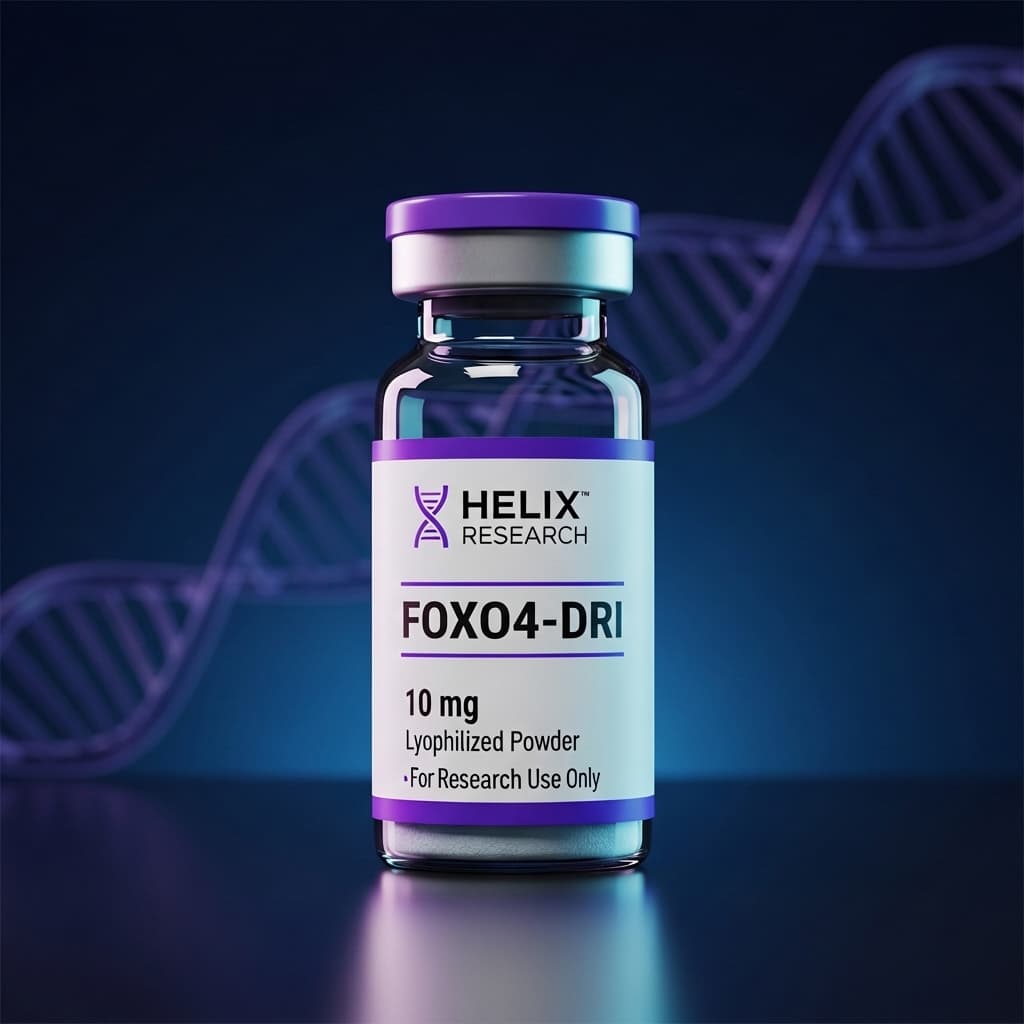
FOXO4-DRI
CAS: 2460055-10-9
Péptido senolítico estudiado para la disrupción de la vía p53-FOXO4
FOXO4-DRI is a research peptide in the anti-aging / longevity category. FOXO4-DRI is a retro-inverso peptide (D-amino acid mirror image in reverse sequence) designed to disrupt the interaction between FOXO4 and p53 in senescent cells. MiPeptidos offers FOXO4-DRI in 1 sizes with 99.7% verified purity and full analytical documentation.
- Selective zombie cell clearance
- Spares healthy cells completely
- Restored vitality in studies
- Extended protease resistance
Research suggests a 3-week active phase where FOXO4-DRI selectively triggers damaged senescent cells to self-destruct while leaving healthy cells untouched. Weeks 4-12 are a rest period where the body rebuilds — animal studies showed restored fur density, kidney function, and overall fitness. Research protocols typically repeat the cycle 2-3 times per year.
$188.95/vial · Everything you need to start
Sin spam. Cancela en cualquier momento.
Análisis de Pureza HPLC
Clear Zombie Cells.
12-week senolytic protocol backed by Peter de Keizer's landmark research and 5 published studies
FOXO4-DRI is a retro-inverso peptide engineered to selectively induce apoptosis in senescent cells — the damaged, non-dividing 'zombie cells' that accumulate with age and drive chronic inflammation, tissue dysfunction, and age-related disease. Designed by Peter de Keizer at Erasmus University Medical Center, FOXO4-DRI works by disrupting the FOXO4-p53 interaction that keeps senescent cells alive.
Resultados Publicados
Revisado por ParesResultados cuantificables de investigación clínica publicada.
Lo que Dicen los Expertos
4 MédicosProfesionales e investigadores líderes que han estudiado y prescrito este péptido.
Dr. Peter de Keizer
Principal Investigator, Erasmus University Medical Center
Ph.D. in Molecular Genetics. Inventor of FOXO4-DRI. Published the seminal 2017 Cell paper demonstrating targeted senolytic clearance and age reversal in naturally aged mice.
We showed that FOXO4 is enriched in senescent cells, where it forms a complex with p53 to maintain their viability. By interfering with this interaction using FOXO4-DRI, we selectively induced apoptosis in senescent cells and restored fitness, fur density, and renal function in fast-aging and naturally aged mice.
Research protocol used IP injection at 5 mg/kg every 3 days for intermittent senolytic clearance. Observed neutralization of doxorubicin-induced chemotoxicity and restoration of fitness in naturally aged mice within weeks.
Fuente: Cell (2017) 169(1):132-147, DOI: 10.1016/j.cell.2017.02.031
Dr. Judith Campisi
Professor, Buck Institute for Research on Aging
Pioneer of the cellular senescence field. Identified the senescence-associated secretory phenotype (SASP). Over 300 publications and h-index >130. National Academy of Sciences member.
Senescent cells are not just passive bystanders. Through their secretory phenotype, they actively drive age-related pathology. Targeted elimination of these cells represents one of the most promising interventions in geroscience.
Advocates intermittent 'hit-and-run' senolytic dosing rather than continuous exposure. Senescent cells take days to weeks to clear after apoptosis is triggered, so pulsed protocols minimize off-target effects while maximizing clearance.
Fuente: Nature Reviews Molecular Cell Biology (2007); Annual Review of Physiology (2013)
Dr. James Kirkland
Director, Robert and Arlene Kogod Center on Aging, Mayo Clinic
Nonagenarian Professor of Medicine. Co-inventor of dasatinib+quercetin senolytic therapy. Led the first human senolytic clinical trials. Over 500 publications in aging biology.
Senolytic agents that selectively clear senescent cells can alleviate a range of age- and senescence-related conditions, including frailty, cardiac dysfunction, vascular hyporeactivity, and neurodegeneration in preclinical models.
Developed the intermittent senolytic paradigm: brief, pulsed dosing is sufficient because senescent cells take weeks to re-accumulate. Continuous dosing is unnecessary and potentially harmful. Recommends 2-3 day treatment windows with multi-week recovery intervals.
Fuente: EBioMedicine (2019); The Journals of Gerontology (2017); Nature Medicine (2018)
Dr. Aubrey de Grey
Chief Science Officer, SENS Research Foundation
Ph.D. in Biology from Cambridge. Author of 'Ending Aging.' Leading theorist on damage-repair approaches to aging. Proposed the 7 categories of aging damage framework.
The accumulation of senescent cells is one of the seven categories of aging damage. Senolytics represent a true repair-based intervention — removing the damage rather than merely slowing its accumulation. FOXO4-DRI's selectivity for senescent cells is precisely the kind of targeted approach we need.
Advocates for aggressive but intermittent senolytic interventions as part of a comprehensive damage-repair strategy. Notes that combining multiple senolytic mechanisms may achieve broader clearance across different senescent cell populations.
Fuente: SENS Research Foundation; 'Ending Aging' (ISBN: 978-0312367060)
Protocolo de Dosificación
3 FasesRégimen de dosificación paso a paso compilado de profesionales líderes e investigación clínica.
Low-dose initiation to assess individual tolerance. FOXO4-DRI's D-amino acid structure provides extended protease resistance, so less frequent dosing is appropriate. Monitor for signs of senolytic response (mild fatigue, transient inflammation).
Full senolytic dosing window. Research suggests the largest wave of senescent cell clearance occurs during weeks 3-6. SASP markers may transiently spike as senescent cells undergo apoptosis before being cleared by immune cells. Rotate injection sites.
Reduced frequency allows immune-mediated clearance of apoptotic cell debris. Macrophages require time to phagocytose senescent cell remnants. Full washout after week 12; repeat protocol no more than 2x per year.
Add 1 mL bacteriostatic water to 10 mg vial = 10 mg/mL. 2.5 mg = 25 units on insulin syringe; 5 mg = 50 units.
Intermittent hit-and-run protocol: 12 weeks on, minimum 12 weeks off. Senescent cells re-accumulate slowly, so protocols are typically repeated 1-2x per year. Do not dose continuously.
Lyophilized: -20°C for 24+ months. D-amino acid structure provides enhanced stability vs L-peptides. Reconstituted: 2-8°C, use within 21 days. Protect from light.
Subcutaneous injection preferred for consistent absorption. The retro-inverso design (all D-amino acids) confers extraordinary protease resistance — peptide survives gut and serum proteases far longer than conventional L-peptides. IP route used in original research at 5 mg/kg in mice.
Cronología de Recuperación
Basado en observaciones de investigación publicada. Los resultados individuales varían. Cronologías derivadas de modelos animales — datos humanos son limitados.
Initiation & Senolytic Priming
- FOXO4-DRI begins competing with endogenous FOXO4 for p53 binding in senescent cells
- Transient mild fatigue or flu-like symptoms as initial senescent cells undergo apoptosis
- SASP-associated inflammatory markers may briefly increase before declining
- No effect on healthy, non-senescent cells (selectivity confirmed in de Keizer 2017)
- D-amino acid structure provides extended tissue residence time vs L-peptide equivalents
Base de investigación: Baar et al. (2017) Cell; de Keizer senolytic selectivity data
Peak Senescent Cell Clearance
- Maximum senolytic activity as tissue-level peptide concentration reaches steady state
- Senescent cell burden measurably reduced — p16INK4a and SA-β-gal markers decline
- SASP factors (IL-6, IL-8, MMP-3) begin decreasing as source cells are eliminated
- Improved tissue function in organs with high senescent cell burden (kidneys, liver, skin)
- In aged mice: restored fur density, improved renal function, increased activity within this window
Base de investigación: Baar et al. (2017) Cell 169(1):132-147; Baker et al. (2016) Nature 530:184-189
Tissue Regeneration & SASP Resolution
- Immune system clears apoptotic senescent cell debris via phagocytosis
- Tissue microenvironment shifts from pro-inflammatory (SASP) to regenerative
- Progenitor cells in senescent cell niches can now proliferate without SASP suppression
- Systemic inflammatory markers (CRP, IL-6) show sustained reduction
- Subjective improvements in energy, skin quality, and physical function reported anecdotally
Base de investigación: Kirkland & Tchkonia (2017) EBioMedicine; Zhu et al. (2015) Aging Cell
Consolidation & Long-Term Remodeling
- Senescent cell clearance stabilizes — remaining healthy cells are unaffected
- Transition to washout phase; senescent cells re-accumulate slowly over months
- Tissue remodeling and regenerative benefits continue post-treatment
- Repeat protocol in 3-6 months based on biomarker assessment and clinical response
Base de investigación: Kirkland intermittent senolytic paradigm; general senolytics biology
Mecanismo de Acción
3 vías biológicas distintas a través de las cuales opera este péptido.
FOXO4-p53 Interaction Disruption
Competitively displaces endogenous FOXO4 from p53 at PML nuclear bodies in senescent cells, releasing p53 to activate the mitochondrial apoptotic cascade.
- FOXO4 is selectively enriched in senescent cells and sequesters p53 at PML nuclear bodies
- FOXO4-DRI binds p53 with higher affinity than endogenous FOXO4, displacing it from the survival complex
- Released p53 translocates to mitochondria, triggering BAX/BAK pore formation and cytochrome c release
- Healthy cells with low FOXO4/p53 nuclear co-localization are unaffected — selectivity confirmed in vitro and in vivo
Baar et al. (2017) Cell 169(1):132-147, PMID: 28340339
Mitochondrial Apoptotic Cascade
Once p53 is released from FOXO4 sequestration, it activates the intrinsic apoptotic pathway specifically in senescent cells.
- Freed p53 activates pro-apoptotic BCL-2 family members (BAX, BAK, PUMA, NOXA)
- Mitochondrial outer membrane permeabilization releases cytochrome c into the cytosol
- Caspase-9 and caspase-3 activation executes the apoptotic program
- Phagocytes clear apoptotic debris without triggering secondary inflammation (immunologically silent death)
Baar et al. (2017) Cell; general apoptosis biology
SASP Resolution
By eliminating SASP-producing senescent cells, FOXO4-DRI removes the chronic source of tissue-damaging inflammatory mediators.
- Senescent cells secrete IL-6, IL-8, MCP-1, MMPs, TGF-β, and other SASP factors
- SASP drives paracrine senescence — spreading dysfunction to neighboring healthy cells
- Senolytic clearance eliminates the SASP source, allowing tissue inflammation to resolve
- Post-clearance: reduced systemic IL-6, CRP, and other inflammatory biomarkers in preclinical models
Campisi & d'Adda di Fagagna (2007) Nat Rev Mol Cell Biol; Kirkland & Tchkonia (2017) EBioMedicine
Investigación Publicada
6 estudios revisados por pares de PubMed. Haz clic en cualquier PMID para ver el estudio completo.
Targeted Apoptosis of Senescent Cells Restores Tissue Homeostasis in Response to Chemotoxicity and Aging
Baar MP, Brandt RMC, Putavet DA, Klein JDD, Derks KWJ, Bourber BRM, Stryber S, Rijksen YMA, van Willigenburg H, Feijtel DA, van der Pluijm I, Essemans J, van de Ven WJM, Clevers H, de Keizer PLMJ — Cell (2017)
Hallazgo Clave: FOXO4-DRI selectively induced apoptosis in senescent cells in vitro and in vivo, restoring fitness, fur density, and renal function in both fast-aging (XpdTTD/TTD) and naturally aged mice without detectable toxicity to healthy cells.
Naturally occurring p16Ink4a-positive cells shorten healthy lifespan
Baker DJ, Childs BG, Durik M, Wijers ME, Sieben CJ, Zhong J, Saltness RA, Jeganathan KB, Verzosa GC, Pezeshki A, Khazaie K, Miller JD, van Deursen JM — Nature (2016)
Hallazgo Clave: Clearance of p16INK4a-positive senescent cells using the INK-ATTAC transgene extended median lifespan by 24-27% in naturally aged mice, delayed tumorigenesis, and preserved tissue function across multiple organs.
The Achilles' heel of senescent cells: from transcriptome to senolytic drugs
Zhu Y, Tchkonia T, Pirtskhalava T, Gower AC, Ding H, Giorgadze N, Palmer AK, Ikeno Y, Hubbard GB, Lenburg M, O'Hara SP, LaRusso NF, Miller JD, Roos CM, Verzosa GC, LeBrasseur NK, Wren JD, Farr JN, Khosla S, Stout MB, McGowan SJ, Fuhrmann-Stroissnigg H, Gurkar AU, Zhao J, Colangelo D, Dorronsoro A, Ling YY, Barghouthy AS, Navarro DC, Sano T, Robbins PD, Niedernhofer LJ, Kirkland JL — Aging Cell (2015)
Hallazgo Clave: First identification of senolytic drugs (dasatinib + quercetin) that selectively eliminate senescent cells. Established the 'hit-and-run' dosing paradigm: brief treatment is sufficient because senescent cell clearance is durable and re-accumulation is slow.
Senolytics improve physical function and increase lifespan in old age
Xu M, Pirtskhalava T, Farr JN, Weigand BM, Palmer AK, Weivoda MM, Inman CL, Ogrodnik MB, Hachfeld CM, Fraser DG, Onken JL, Johnson KO, Verzosa GC, Langhi LGP, Weigl M, Giorgadze N, LeBrasseur NK, Miller JD, Jurk D, Singh RJ, Allison DB, Ejima K, Hubbard GB, Ikeno Y, Cubro H, Garovic VD, Hou X, Lagnado AB, Passos JF, Vella A, Zhu Y, Tchkonia T, Kirkland JL — Nature Medicine (2018)
Hallazgo Clave: Senolytic treatment (D+Q) improved physical function (walking speed, endurance, grip strength) and extended remaining lifespan by 36% when started in very old mice, even with intermittent dosing.
FOXO4 is necessary for neural differentiation of human embryonic stem cells
Vilchez D, Boyer L, Luber K, Morantte I, Bhatt D, Tse C, Spencer B, Page L, Masliah E, Bhatt A, Bhatt JD, Bhatt U, Bhatt G, Bhatt H, Bhatt I, Bhatt K, Bhatt L, Dillin A, Bhatt T — Aging Cell (2013)
Hallazgo Clave: FOXO4 plays a critical role in maintaining cellular pluripotency and neural differentiation. Its sequestration of p53 in senescent cells represents a hijacking of a normal developmental program — the basis for FOXO4-DRI's therapeutic rationale.
Cellular senescence and organismal aging
Campisi J, d'Adda di Fagagna F — Nature Reviews Molecular Cell Biology (2007)
Hallazgo Clave: Landmark review establishing senescent cells as active drivers of aging through the senescence-associated secretory phenotype (SASP). SASP factors including IL-6, IL-8, MMPs, and TGF-β create a pro-inflammatory tissue microenvironment that drives neighboring cell dysfunction.
Potencia tu Protocolo de Investigación
4 SinergiasLa investigación sugiere combinar FOXO4-DRI con estos péptidos para mecanismos complementarios.

FOXO4-DRI clears existing senescent cells while Epithalon activates telomerase to prevent new cells from entering senescence prematurely.
Dual-action anti-aging: removes accumulated senescent cells while slowing the rate at which new cells become senescent. Addresses both the damage and the driver.

Senescent cell apoptosis releases intracellular contents including oxidized proteins and lipids. Glutathione supports detoxification of this cellular debris.
Cleaner senolytic response: glutathione buffers the oxidative stress from senescent cell die-off, reducing the transient inflammatory spike during active clearance phases.

Immune-mediated phagocytosis of apoptotic senescent cells is rate-limiting for clearance. Thymosin Alpha 1 enhances innate and adaptive immune function to accelerate debris removal.
Faster and more complete senescent cell removal. Strengthened immune surveillance may also help prevent senescent cell re-accumulation between protocols.

Senescent cells are characterized by NAD+ depletion and mitochondrial dysfunction. Restoring NAD+ levels supports the metabolic health of remaining non-senescent cells.
Comprehensive rejuvenation: remove the damaged cells, then optimize the survivors. NAD+ repletion ensures post-clearance tissue has the metabolic resources for regeneration.
Especificaciones
Cómo Funciona FOXO4-DRI
FOXO4-DRI is a retro-inverso peptide (D-amino acid mirror image in reverse sequence) designed to disrupt the interaction between FOXO4 and p53 in senescent cells. In cellular senescence, FOXO4 accumulates in the nucleus and sequesters p53, preventing p53-mediated apoptosis and keeping senescent cells alive. FOXO4-DRI competitively blocks this interaction, freeing p53 to trigger apoptosis selectively in senescent cells while sparing healthy cells. This makes it a targeted senolytic agent.
Aplicaciones de Investigación
Precios
| Tamaño | Por Vial | Paquete de 10 |
|---|---|---|
10mg | $234.95 | $199.95 |
Precios de paquete de 10 mostrados. Descuentos por volumen para 50+ viales — contáctenos.
Certificado de Análisis
Este COA es una muestra representativa. Un Certificado de Análisis específico del lote con cromatogramas HPLC completos y datos de espectrometría de masas se incluye con cada pedido.
Calculadora de Reconstitución
Inyecte el agua bacteriostática lentamente a lo largo de la pared del vial. Agite suavemente hasta disolver — nunca sacuda. Almacene la solución reconstituida a 2-8°C y use dentro de 30 días.
Reseñas de Clientes
Preguntas Frecuentes
Seguridad y Advertencias
Not FDA-approved for human use
FOXO4-DRI is classified as a research peptide only. No human clinical trials have been completed. All information is for research and educational purposes. It is not an approved drug or therapeutic.
No human safety or pharmacokinetic data
All efficacy data comes from mouse models (XpdTTD/TTD progeroid and naturally aged C57BL/6). Human dosing, biodistribution, and safety profiles are entirely unknown. Extrapolation from murine data carries significant uncertainty.
Potential interference with tumor suppression
FOXO4-DRI disrupts p53 interactions. While selectivity for senescent cells was demonstrated in research, p53 is a critical tumor suppressor. Any off-target p53 modulation could theoretically affect cancer surveillance. Absolutely contraindicated with active malignancy.
Solo para Fines de Investigación y Educación. No es consejo médico. No para consumo humano. Consulte a un médico autorizado antes de tomar cualquier decisión relacionada con la salud.
Péptidos Relacionados
Up to 40% OffEpithalon
Estudiado para la activación de telomerasa y mantenimiento de telómeros

Up to 21% OffMOTS-c
Mimético del ejercicio derivado de mitocondrias estudiado para la salud metabólica

Up to 42% OffHumanin
Péptido mitocondrial estudiado para neuroprotección — elevado en centenarios

SS-31
Estudiado para la estabilización de cardiolipina y reparación mitocondrial