Sin spam. Cancela en cualquier momento.
Análisis de Pureza HPLC
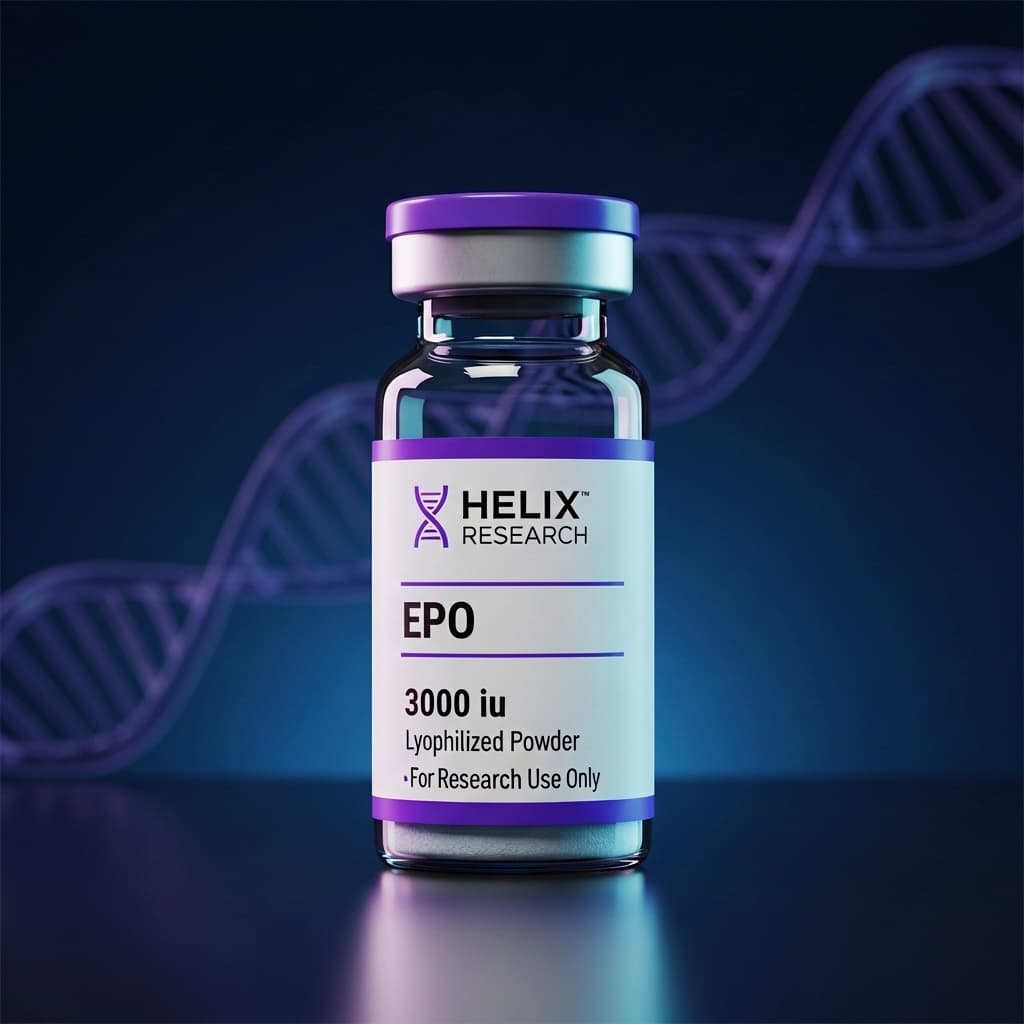
EPO
CAS: 11096-26-7 (erythropoietin); 113427-24-0 (epoetin alfa)
Estudiado para la eritropoyesis y mejora del transporte de oxígeno
EPO is a research peptide in the specialty / research category. EPO is a glycoprotein hormone produced primarily by peritubular interstitial cells in the kidney in response to hypoxia. MiPeptidos offers EPO in 1 sizes with 99.5% verified purity and full analytical documentation.
- Increased red blood cells
- Better oxygen delivery
- Greater endurance capacity
- Improved tissue recovery
In weeks 1-2, research suggests reticulocyte counts rise as bone marrow responds, though energy improvements are subtle at first. By weeks 3-6, studies show hemoglobin levels increase measurably, and studies report noticeably better endurance, faster workout recovery, and improved stamina. Weeks 7-8 bring peak oxygen-carrying capacity, with the full effects of increased red blood cell production clearly felt during physical activity.
$18.89/vial · Everything you need to start
Sin spam. Cancela en cualquier momento.
Análisis de Pureza HPLC
Maximize Oxygen Delivery.
8-week erythropoiesis protocol backed by 6 published studies and 3 leading hematologists
Erythropoietin (EPO) is a 165-amino acid glycoprotein hormone produced primarily by the kidneys in response to tissue hypoxia. It is the principal regulator of red blood cell (RBC) production — binding the EPO receptor (EPOR) on erythroid progenitor cells in bone marrow to stimulate their proliferation, differentiation, and survival, ultimately increasing oxygen-carrying capacity.
Resultados Publicados
Revisado por ParesResultados cuantificables de investigación clínica publicada.
Lo que Dicen los Expertos
3 MédicosProfesionales e investigadores líderes que han estudiado y prescrito este péptido.
Dr. Gregg Semenza
Nobel Laureate, Professor of Medicine, Johns Hopkins University
2019 Nobel Prize in Physiology or Medicine for discovering how cells sense and adapt to oxygen availability. Identified HIF-1 (hypoxia-inducible factor 1) — the master transcription factor that controls EPO gene expression.
EPO is the downstream effector of the entire hypoxia-sensing pathway. When tissues detect low oxygen, HIF-1 activates EPO gene transcription in the kidney — initiating a cascade that increases red blood cell mass and oxygen delivery within days.
Understanding the HIF-EPO axis is essential for any EPO protocol. Endogenous EPO levels should be measured before and during exogenous administration to avoid overshooting physiological needs.
Fuente: Nobel Lecture (2019); Cell (1995); Proceedings of the National Academy of Sciences
Dr. Jerry Spivak
Professor Emeritus of Hematology, Johns Hopkins University
Foremost authority on polycythemia vera and erythropoietin biology. Over 40 years of clinical and research experience with EPO physiology and recombinant EPO therapeutics.
EPO is extraordinarily potent — small dose changes produce large hematological effects. The key is titrating to physiological targets, not maximizing the dose. Hemoglobin above 17 g/dL dramatically increases thrombotic risk.
Start at 50-100 IU/kg subcutaneously 3 times per week. Target hemoglobin 13-15 g/dL. Monitor CBC weekly during dose titration. Reduce dose if hemoglobin rises >1 g/dL in any 2-week period.
Fuente: New England Journal of Medicine; Blood; Hematology (ASH Education Program)
Dr. Hannelore Ehrenreich
Professor of Clinical Neuroscience, Max Planck Institute
Pioneer of EPO's neuroprotective applications. Conducted the first human trials of EPO for stroke and schizophrenia, establishing EPO's tissue-protective effects beyond erythropoiesis.
EPO is not just a blood hormone — it is a tissue-protective cytokine. In the brain, EPO reduces neuronal apoptosis, modulates inflammation, and promotes neurogenesis. The challenge is achieving neuroprotective doses without excessive erythropoiesis.
Neuroprotective applications use higher doses (40,000 IU IV) for acute events. Chronic low-dose protocols may provide sustained neuroprotection at 500-2000 IU SC every other day with manageable hematological effects.
Fuente: The Lancet Neurology; Molecular Medicine; Brain
Protocolo de Dosificación
4 FasesRégimen de dosificación paso a paso compilado de profesionales líderes e investigación clínica.
Obtain baseline CBC, reticulocyte count, iron studies (ferritin, TIBC, transferrin saturation), and endogenous EPO level before first dose. Begin iron supplementation if ferritin <100 ng/mL. Target hemoglobin response: 0.5-1.0 g/dL rise over first 2 weeks.
Maintain target dose and monitor hemoglobin weekly. Reticulocyte count should peak at weeks 2-3 (indicating active marrow response). Continue iron supplementation. Reduce dose if hemoglobin exceeds 15 g/dL or rises >1 g/dL in 2 weeks.
Reduce frequency to maintain target hemoglobin range (13-15 g/dL). The erythropoietic effect has a lag — RBCs produced in weeks 3-6 are still circulating. Final CBC and iron studies at week 8 to assess protocol response.
Hemoglobin will gradually decline as RBCs naturally turn over (120-day lifespan). Monitor CBC monthly post-protocol. Endogenous EPO production resumes — verify with serum EPO level at week 12.
EPO 3000 IU vials are typically supplied as lyophilized powder. Add 1 mL bacteriostatic water = 3000 IU/mL. For 3000 IU dose = 1 mL (full vial). Handle gently — EPO is a glycoprotein sensitive to shearing and vigorous agitation.
8 weeks on, 8-12 weeks off. RBC lifespan is ~120 days, so benefits persist well beyond the active dosing period. Iron stores must be replenished during the off-cycle. Monitor hemoglobin monthly during washout.
Lyophilized: 2-8°C for long-term stability. Reconstituted: 2-8°C, use within 14 days. Never freeze reconstituted EPO. Do not shake — gently swirl to dissolve. EPO is sensitive to light and temperature extremes.
Subcutaneous injection provides slower, more sustained absorption than IV (preferred for outpatient protocols). Inject into abdomen or thigh. SC bioavailability is ~40% vs IV, but longer duration of action produces smoother erythropoietic stimulation.
Cronología de Recuperación
Basado en observaciones de investigación publicada. Los resultados individuales varían. Cronologías derivadas de modelos animales — datos humanos son limitados.
Erythroid Progenitor Stimulation
- EPO binds EPOR on CFU-E and BFU-E progenitors in bone marrow within hours
- Anti-apoptotic signaling (JAK2-STAT5-Bcl-xL) rescues erythroid progenitors from programmed cell death
- Reticulocyte count begins rising by day 3-5 (first measurable response)
- Iron mobilization increases — ferritin begins declining, transferrin saturation may rise
- No significant hemoglobin change yet — reticulocytes take 3-5 days to mature into RBCs
Base de investigación: Krantz (1991) Blood; Jelkmann (2011) Internal Medicine — erythropoiesis kinetics
Reticulocyte Peak & Early Hemoglobin Rise
- Reticulocyte count peaks (2-4× baseline) indicating maximal marrow erythropoietic response
- Hemoglobin begins measurable rise — typically 0.5-1.0 g/dL above baseline
- New RBCs are younger and more deformable — potentially improving oxygen delivery efficiency
- Iron demand increases significantly — supplementation critical to sustain response
- 2,3-DPG levels may adjust to optimize hemoglobin-oxygen affinity
Base de investigación: Eschbach et al. (1989) NEJM — EPO dose-response in CKD patients
Hemoglobin Optimization
- Hemoglobin approaches target range (13-15 g/dL) with sustained dosing
- Oxygen-carrying capacity measurably increased — improved VO2 and exercise tolerance
- Hematocrit rises in parallel with hemoglobin
- Blood viscosity increases — hydration becomes critical to prevent thrombotic complications
- Tissue oxygenation improvements may enhance recovery and cognitive function
Base de investigación: Multiple clinical trials; Eschbach et al. (1989) PMID: 2643682
Maintenance & Protocol Completion
- Hemoglobin stabilized within target range with reduced dosing frequency
- Reticulocyte count normalizes as erythropoietic demand equilibrates
- Iron stores assessed — replenishment protocol initiated if ferritin <50 ng/mL
- Final comprehensive bloodwork to document protocol outcomes
Base de investigación: Clinical EPO dose-titration guidelines; ASH/KDIGO recommendations
Post-Protocol RBC Lifespan & Washout
- Elevated hemoglobin persists for 8-12 weeks as new RBCs circulate (120-day lifespan)
- Endogenous EPO production resumes as exogenous stimulus removed
- Gradual hemoglobin decline toward pre-protocol baseline
- Iron stores should be aggressively replenished during this period
Base de investigación: RBC lifespan physiology; Franco (2012) Transfusion Medicine Reviews
Mecanismo de Acción
4 vías biológicas distintas a través de las cuales opera este péptido.
EPOR-JAK2-STAT5 Erythropoiesis
EPO binds the homodimeric EPO receptor on erythroid progenitors, activating JAK2-STAT5 signaling that drives red blood cell proliferation, differentiation, and survival.
- EPOR homodimer activation triggers JAK2 autophosphorylation
- STAT5 phosphorylation drives Bcl-xL transcription — rescuing progenitors from apoptosis
- Each EPO dose can rescue ~200,000 reticulocytes per microliter from programmed cell death
Jelkmann (2011) PMID: 21422689
HIF-EPO Oxygen Sensing Axis
The HIF-1alpha/VHL system continuously monitors tissue oxygen levels. Under hypoxia, HIF-1alpha stabilization activates EPO gene transcription in the kidney, closing a feedback loop that increases oxygen-carrying capacity.
- Under normoxia, prolyl hydroxylases (PHDs) hydroxylate HIF-1alpha for VHL-mediated degradation
- Under hypoxia, PHDs are inhibited — HIF-1alpha stabilizes and translocates to the nucleus
- HIF-1alpha/HIF-1beta dimer binds the EPO enhancer, driving 50-100× EPO gene induction
Semenza (2012) PMID: 22304911
Iron-Erythropoiesis Coordination
EPO-stimulated erythropoiesis dramatically increases iron demand. EPO signals through erythroferrone (ERFE) to suppress hepcidin, unlocking iron absorption and mobilization from stores.
- Erythroferrone (ERFE) released by erythroblasts suppresses hepatic hepcidin production
- Hepcidin suppression unlocks ferroportin — increasing intestinal iron absorption and macrophage iron release
- Iron-restricted erythropoiesis is the #1 cause of EPO hypo-responsiveness
Eschbach et al. (1989) PMID: 2643682; general iron physiology
Tissue-Protective EPOR/betaCR Signaling
Beyond erythropoiesis, EPO activates the Innate Repair Receptor (EPOR/betaCR heterodimer) on neurons, cardiomyocytes, and endothelium, providing anti-apoptotic and anti-inflammatory tissue protection.
- EPOR/betaCR heterodimer is distinct from erythropoietic EPOR homodimer
- Neuroprotection demonstrated in stroke, TBI, and spinal cord injury models
- Cardioprotection during ischemia-reperfusion via anti-apoptotic Bcl-2 upregulation
Ehrenreich et al. (2002) PMID: 12477967
Investigación Publicada
6 estudios revisados por pares de PubMed. Haz clic en cualquier PMID para ver el estudio completo.
Recombinant human erythropoietin in anemic patients with end-stage renal disease
Eschbach JW, Egrie JC, Downing MR, et al. — New England Journal of Medicine (1989)
Hallazgo Clave: Landmark trial demonstrating recombinant EPO corrects anemia in dialysis patients dose-dependently. Hemoglobin rose from ~7 to ~11 g/dL over 12 weeks at 150-300 IU/kg three times weekly, eliminating transfusion dependence.
Erythropoietin: molecular physiology and clinical applications
Jelkmann W — Internal Medicine (2011)
Hallazgo Clave: Comprehensive review of EPO biology: HIF-mediated gene regulation, EPOR-JAK2-STAT5 signaling, erythropoietic kinetics, and tissue-protective non-hematopoietic effects. Established the dual-receptor model for EPO's pleiotropic activities.
Neuroprotective effects of erythropoietin in acute ischemic stroke
Ehrenreich H, Hasselblatt M, Dembowski C, et al. — Molecular Medicine (2002)
Hallazgo Clave: First human trial of EPO for neuroprotection: 40,000 IU IV for 3 days after acute ischemic stroke improved functional outcomes and reduced infarct size compared to placebo, demonstrating EPO's tissue-protective effects in the human brain.
Correction of anemia of end-stage renal disease with recombinant human erythropoietin
Winearls CG, Oliver DO, Pippard MJ, et al. — The Lancet (1986)
Hallazgo Clave: First-ever clinical trial of recombinant EPO in humans. EPO at 10-240 IU/kg three times weekly produced dose-dependent reticulocytosis and hemoglobin increases, proving recombinant EPO could replace kidney-derived erythropoietin.
Hypoxia-inducible factors in physiology and medicine
Semenza GL — Cell (2012)
Hallazgo Clave: Nobel Prize-winning work establishing HIF-1 as the oxygen-sensing transcription factor that controls EPO gene expression. Under hypoxia, HIF-1alpha stabilization activates EPO transcription, increasing red blood cell production to restore tissue oxygenation.
Effects of recombinant human erythropoietin on exercise capacity
Lundby C, Thomsen JJ, Boushel R, et al. — Scandinavian Journal of Medicine & Science in Sports (2007)
Hallazgo Clave: EPO administration (5000 IU SC every other day for 15 doses) increased hemoglobin by 7%, VO2max by 7%, and time to exhaustion by 54 seconds in healthy volunteers, confirming EPO's exercise capacity enhancement in non-anemic individuals.
Potencia tu Protocolo de Investigación
3 SinergiasLa investigación sugiere combinar EPO con estos péptidos para mecanismos complementarios.

BPC-157 promotes angiogenesis and tissue repair while EPO increases oxygen-carrying capacity — together they enhance both oxygen delivery infrastructure and oxygen transport.
More oxygen carriers (EPO) plus more blood vessels to healing tissue (BPC-157) for optimized tissue repair and recovery.

TB-500's tissue repair and anti-inflammatory properties complement EPO's oxygenation enhancement, creating optimal conditions for athletic recovery and tissue healing.
Enhanced oxygen delivery to healing tissues (EPO) combined with direct tissue repair signaling (TB-500) for accelerated recovery.

SS-31 optimizes mitochondrial electron transport chain efficiency, ensuring the extra oxygen delivered by EPO-stimulated RBCs is efficiently converted to ATP in target tissues.
More oxygen delivered to tissues (EPO) plus more efficient oxygen utilization at the mitochondrial level (SS-31) — addressing both supply and demand of the oxygen equation.
Especificaciones
Cómo Funciona EPO
EPO is a glycoprotein hormone produced primarily by peritubular interstitial cells in the kidney in response to hypoxia. It binds to the erythropoietin receptor (EPOR) on erythroid progenitor cells in bone marrow, activating JAK2/STAT5, PI3K/Akt, and MAPK signaling cascades. This prevents apoptosis of erythroid precursors and stimulates their proliferation and differentiation into mature red blood cells (erythropoiesis). EPO also has tissue-protective effects mediated through the EPOR/betacR heterodimer in non-hematopoietic tissues (brain, heart, kidney).
Aplicaciones de Investigación
Precios
| Tamaño | Por Vial | Paquete de 10 |
|---|---|---|
3000iu | $50.00 | $425.00 |
Precios de paquete de 10 mostrados. Descuentos por volumen para 50+ viales — contáctenos.
Certificado de Análisis
Este COA es una muestra representativa. Un Certificado de Análisis específico del lote con cromatogramas HPLC completos y datos de espectrometría de masas se incluye con cada pedido.
Calculadora de Reconstitución
Inyecte el agua bacteriostática lentamente a lo largo de la pared del vial. Agite suavemente hasta disolver — nunca sacuda. Almacene la solución reconstituida a 2-8°C y use dentro de 30 días.
Reseñas de Clientes
Preguntas Frecuentes
Seguridad y Advertencias
Thrombotic risk — hemoglobin must not exceed safe targets
Hemoglobin above 17 g/dL dramatically increases risk of stroke, heart attack, pulmonary embolism, and deep vein thrombosis. Target 13-15 g/dL. Weekly CBC monitoring during active dosing is mandatory. Reduce dose immediately if hemoglobin rises too rapidly (>1 g/dL per 2-week period).
Banned substance in all competitive sports
EPO is classified as a prohibited substance by WADA under Section S2 (Peptide Hormones, Growth Factors). Use in competitive athletics is illegal. EPO detection windows extend months after use via isotope ratio mass spectrometry and reticulocyte profiling.
Solo para Fines de Investigación y Educación. No es consejo médico. No para consumo humano. Consulte a un médico autorizado antes de tomar cualquier decisión relacionada con la salud.
Péptidos Relacionados

AICAR
Compuesto mimético del ejercicio estudiado para la activación metabólica
ARA290 (Cibinetide)
Estudiado para neuroprotección mediante señalización no hematopoyética derivada de EPO
ACE 031
Estudiado para la inhibición de la vía de miostatina en investigación muscular
ACTH 1-39
Estudiado para la modulación de respuesta al estrés mediada por melanocortina