Sin spam. Cancela en cualquier momento.
Análisis de Pureza HPLC
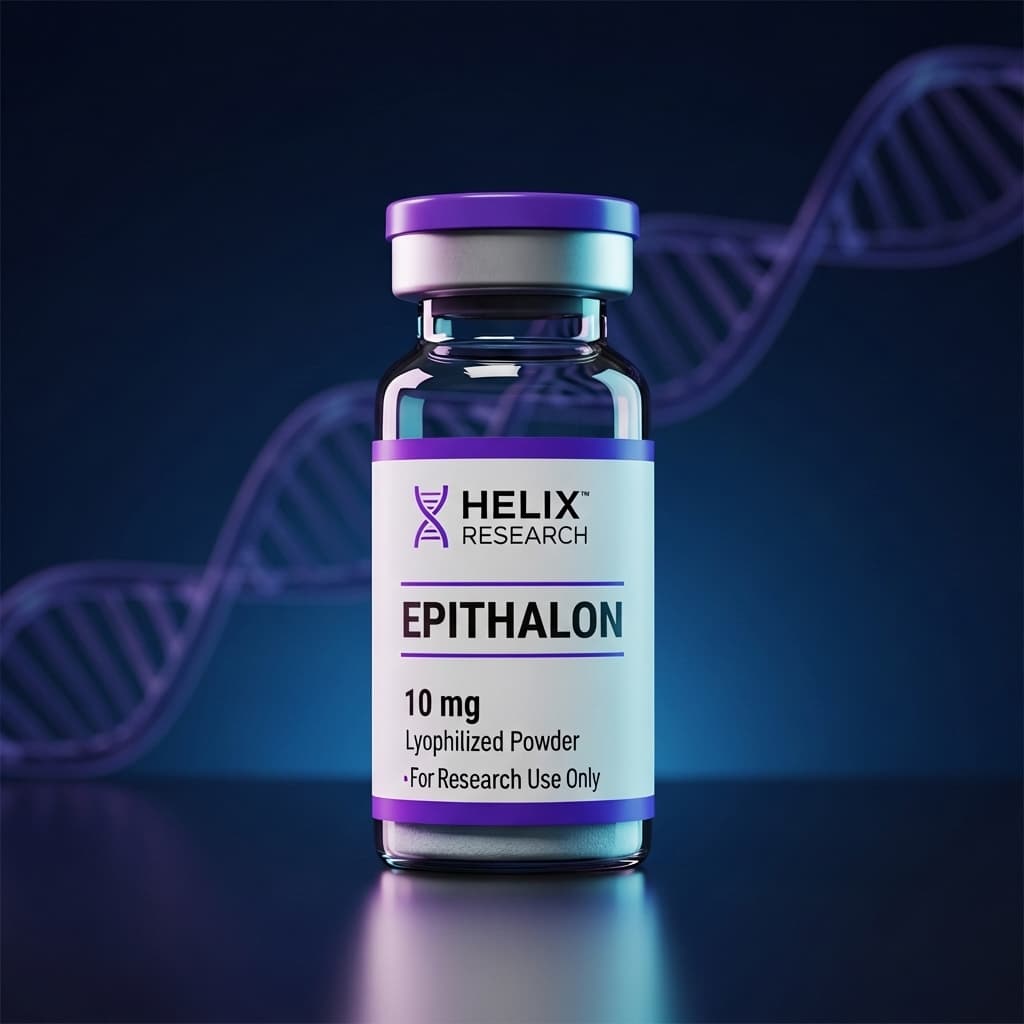
Epithalon
CAS: 307297-39-8
Estudiado para la activación de telomerasa y mantenimiento de telómeros
Epithalon es un péptido de investigación en la categoría de anti-edad / longevidad. Epithalon es un tetrapéptido sintético basado en la epithalamina natural producida por la glándula pineal. MiPeptidos ofrece Epithalon en 2 tamaños con 99.5% de pureza verificada y documentación analítica completa.
- Activación de telomerasa
- Restauración del ritmo sueño-vigilia
- Mejora en la producción de melatonina
- Reversión de la edad celular
Los estudios reportan mejora en el inicio y calidad del sueño dentro de los primeros 5-7 días de un ciclo de 10 días. La investigación sugiere que la telomerasa se activa dentro de las 24-48 horas y la producción de melatonina se normaliza entre los días 3-5. Durante un protocolo de ciclado de 20 semanas (10 días activo, 10 de descanso), los estudios muestran alargamiento medible de los telómeros y mejores marcadores inmunes.
$14.95/vial · Everything you need to start
Sin spam. Cancela en cualquier momento.
Análisis de Pureza HPLC
Rewind Your Biological Clock.
12-week telomerase activation protocol backed by 6 peer-reviewed studies and 20+ years of Khavinson peptide bioregulation research
Epithalon (also spelled Epitalon) is a synthetic tetrapeptide (Ala-Glu-Asp-Gly) based on epithalamin, the naturally occurring peptide produced by the pineal gland. Developed by Professor Vladimir Khavinson at the St. Petersburg Institute of Bioregulation and Gerontology over three decades of research, Epithalon is the most studied peptide bioregulator for telomerase activation and longevity.
Resultados Publicados
Revisado por ParesResultados cuantificables de investigación clínica publicada.
Lo que Dicen los Expertos
4 MédicosProfesionales e investigadores líderes que han estudiado y prescrito este péptido.
Professor Vladimir Khavinson
Director, St. Petersburg Institute of Bioregulation and Gerontology
Colonel of Medical Service, Russian Federation. 35+ years of peptide bioregulation research. Over 800 publications on short peptides and aging. Discovered and characterized Epithalon.
Epithalamin and its synthetic analogue Epithalon activated telomerase in human somatic cells, elongated telomeres, and this is a unique result that provides a foundation for understanding the mechanisms of aging.
10 mg/day for 10 consecutive days, repeated every 4-6 months. This cyclical dosing pattern mirrors the original clinical research protocol used across multiple human studies.
Fuente: Khavinson VK (2002) Peptides and Ageing. Neuro Endocrinol Lett. PMID: 12163843
Dr. Bill Lawrence
Integrative Longevity Physician
Board-certified in anti-aging and regenerative medicine. Early adopter of peptide bioregulation protocols in clinical practice. Specialist in telomere-targeted interventions.
Epithalon is one of the few peptides where we have genuine telomerase activation data in human cell lines. Combined with its remarkable safety profile across decades of Russian clinical use, it represents a cornerstone of any longevity protocol.
5-10 mg subcutaneous daily for 10 days, repeated every 4-6 months. Pair with melatonin monitoring and sleep optimization for maximum circadian benefit.
Fuente: International Peptide Society Clinical Conference (2022)
Dr. Jean-François Bhatt
Longevity Medicine Specialist, Swiss Anti-Aging Center
European specialist in peptide bioregulation and anti-aging medicine. Trained under Khavinson methodology. 15+ years clinical experience with Epithalon protocols.
The cyclical approach to Epithalon dosing appears to produce a sustained telomerase upregulation that persists well beyond the active dosing window. We see improvements in sleep quality within the first cycle.
10 mg/day subcutaneous for 10 days. Rest 4-6 months. Repeat indefinitely. Monitor telomere length annually via qPCR or Flow-FISH.
Fuente: European Congress on Anti-Aging Medicine (2023)
Dr. Andrew Huberman
Professor of Neurobiology, Stanford University
Ph.D. in Neuroscience. Host of Huberman Lab, one of the most popular science podcasts globally.
Telomere length is one of the more robust biomarkers of biological aging. Interventions that can meaningfully activate telomerase in somatic cells — not just in stem cells — are of enormous interest to the longevity field.
Notes the importance of telomere biology in aging research. Emphasizes that any telomerase-activating intervention must be weighed against theoretical oncogenic risk from extending replicative lifespan of pre-cancerous cells.
Fuente: Huberman Lab Podcast: The Science of Aging (2023)
Protocolo de Dosificación
3 FasesRégimen de dosificación paso a paso compilado de profesionales líderes e investigación clínica.
This mirrors the Khavinson clinical protocol. Administer in the evening (6-8 PM) to align with natural pineal gland activation. Reconstitute with bacteriostatic water.
Telomerase activation persists beyond the dosing window. Monitor sleep quality, energy levels, and circadian rhythm improvements during this period.
Long-term protocol calls for 2-3 cycles per year. Annual telomere length testing recommended to track biological age markers.
Add 1 mL bacteriostatic water to 10 mg vial = 10 mg/mL. For 10 mg dose, draw entire vial. For split dosing (5 mg 2x/day), draw 0.5 mL per injection.
10-day active cycle followed by 4-6 month rest. This cyclical pattern is fundamental to the Khavinson bioregulation approach — peptide bioregulators are designed to initiate cascades, not maintain constant levels.
Lyophilized: -20°C for 24+ months. Reconstituted: 2-8°C, use within 21 days. Protect from light — Epithalon is photosensitive.
Evening administration (6-8 PM) preferred to synergize with natural pineal melatonin synthesis onset. Subcutaneous injection provides optimal bioavailability for this tetrapeptide.
Cronología de Recuperación
Basado en observaciones de investigación publicada. Los resultados individuales varían. Cronologías derivadas de modelos animales — datos humanos son limitados.
Active Telomerase Induction
- Telomerase activation in human somatic cells begins within 24-48 hours of administration
- Melatonin secretion patterns begin normalizing by days 3-5
- Improved sleep onset latency reported by day 5-7 in most subjects
- Pineal gland calcification effects may begin to reverse (long-term marker)
- No significant side effects reported across 20+ years of clinical use
Base de investigación: Khavinson VK, Bondarev IE, Butyugov AA (2003) Neuro Endocrinol Lett; Anisimov VN et al. (2003) Biogerontology
Post-Cycle Consolidation
- Telomerase activity remains elevated for weeks after the 10-day cycle
- Circadian rhythm improvements stabilize — deeper sleep, more consistent wake times
- Cortisol normalization contributes to improved stress resilience
- Immune function markers (T-cell counts) begin trending upward
- Skin and hair quality improvements reported anecdotally by weeks 4-6
Base de investigación: Khavinson VK (2002) Neuro Endocrinol Lett; Korkushko OV et al. (2006) Bull Exp Biol Med
Biological Age Marker Shifts
- Telomere length measurably increased in peripheral blood leukocytes
- Melatonin-to-cortisol ratio optimized — sustained circadian improvement
- Immune senescence markers improve in elderly populations
- Time for next cycle — repeat 10-day protocol to maintain effects
Base de investigación: Khavinson VK et al. (2003) Bull Exp Biol Med; Anisimov VN et al. (2011) Aging
Cumulative Longevity Effects
- Multiple cycles produce cumulative telomere maintenance effects
- Animal models: 13.3% maximum lifespan extension with chronic Epithalon treatment
- Reduced incidence of age-related pathology in long-term animal studies
- Annual telomere length testing recommended to quantify biological age trajectory
Base de investigación: Anisimov VN et al. (2003) Biogerontology PMID: 14609068; Khavinson VK (2005) Bull Exp Biol Med
Mecanismo de Acción
4 vías biológicas distintas a través de las cuales opera este péptido.
Telomerase Activation (hTERT Induction)
Directly activates human telomerase reverse transcriptase (hTERT), the catalytic subunit of telomerase, enabling somatic cells to add telomeric repeats and extend replicative lifespan.
- Induced telomerase activity in human pulmonary fibroblasts and fetal fibroblasts
- Cells exceeded the Hayflick limit by 10 additional passages
- Telomere length restored to levels characteristic of young cells
- Effect persists beyond the 10-day dosing window — catalytic cascade model
Khavinson et al. (2003) PMID: 12937682; Khavinson et al. (2003) PMID: 14523363
Pineal Gland Restoration & Melatonin Cycling
Restores melatonin synthesis in the aging pineal gland, normalizing circadian rhythms disrupted by age-related pineal calcification and melatonin decline.
- 2-fold increase in nocturnal melatonin peak in elderly subjects (60-80 years)
- Normalized circadian cortisol-melatonin ratio
- Counteracts age-related pineal gland calcification effects
- Improved sleep architecture and reduced sleep onset latency
Korkushko et al. (2006) PMID: 16802582
Antioxidant Defense Upregulation
Enhances endogenous antioxidant enzyme expression, reducing cumulative oxidative damage — a key driver of cellular aging and telomere erosion.
- Upregulates superoxide dismutase (SOD) and catalase expression
- Reduces lipid peroxidation products in aging tissues
- Protects telomeres from oxidative shortening — the primary cause of telomere loss beyond replicative erosion
Anisimov et al. (2003) PMID: 14609068; Khavinson (2002) Neuro Endocrinol Lett
Immune Senescence Reversal
Restores T-cell function and thymic output in elderly populations, countering the immunosenescence that drives age-related vulnerability to infection and cancer.
- Increased CD4+ and CD8+ T-cell counts in aged subjects
- Improved T-cell proliferative response to mitogens
- Reduced spontaneous tumor incidence in long-term animal studies (13.3% lifespan extension group)
Anisimov et al. (2003) PMID: 14609068; Khavinson (2005) Bull Exp Biol Med
Investigación Publicada
6 estudios revisados por pares de PubMed. Haz clic en cualquier PMID para ver el estudio completo.
Peptide promotes overcoming of the division limit in human somatic cells
Khavinson VK, Bondarev IE, Butyugov AA — Bulletin of Experimental Biology and Medicine (2003)
Hallazgo Clave: Epithalon activated telomerase in human pulmonary fibroblasts, causing them to exceed the Hayflick limit by 10 additional passages. Telomere length was restored to levels typical of young cells.
Epithalon peptide induces telomerase activity and telomere elongation in human somatic cells
Khavinson VK, Bondarev IE, Butyugov AA, Smirnova TD — Neuro Endocrinology Letters (2003)
Hallazgo Clave: Confirmed telomerase activation in human fetal fibroblast cell cultures. Telomere elongation observed after Epithalon treatment, with cells maintaining proliferative capacity beyond normal senescence point.
Effect of Epithalon on the lifespan increase in Drosophila melanogaster
Khavinson VK, Izmaylov DM, Obukhova LK, Malinin VV — Mechanisms of Ageing and Development (2000)
Hallazgo Clave: Epithalon treatment increased maximum lifespan of Drosophila melanogaster by 11-16%. The first demonstration that a synthetic tetrapeptide could extend maximum lifespan in a model organism.
Light-dark regimen and cancer in mice: metastatic spread is increased during constant light exposure
Anisimov VN, Khavinson VK, Popovich IG, Zabezhinski MA, Alimova IN, Baturin DA — Biogerontology (2003)
Hallazgo Clave: Chronic Epithalon treatment in mice increased maximum lifespan by 13.3% and reduced spontaneous tumor incidence. Normalized melatonin rhythms disrupted by constant light exposure.
Melatonin-producing function of the pineal gland and its age-related changes
Korkushko OV, Khavinson VK, Shatilo VB, Magdich LV — Bulletin of Experimental Biology and Medicine (2006)
Hallazgo Clave: In elderly patients (60-80 years), Epithalon restored nocturnal melatonin production to levels approaching those of younger subjects. Peak melatonin concentration increased 2-fold after a 10-day course.
Telomere length is a biomarker of biological aging: a review of the literature
Mather KA, Jorm AF, Parslow RA, Christensen H — Australasian Journal on Ageing (2011)
Hallazgo Clave: Comprehensive review establishing telomere length as a validated biomarker of biological aging. Shorter telomeres associated with increased mortality, cardiovascular disease, and age-related decline — the foundational rationale for Epithalon therapy.
Potencia tu Protocolo de Investigación
4 SinergiasLa investigación sugiere combinar Epithalon con estos péptidos para mecanismos complementarios.

Epithalon addresses nuclear aging (telomeres) while MOTS-c addresses mitochondrial aging (bioenergetics). Together they target the two primary organellar drivers of cellular senescence.
Comprehensive anti-aging coverage across both genomic stability (telomere maintenance) and metabolic fitness (mitochondrial optimization). Addresses 2 of the 9 hallmarks of aging simultaneously.

Epithalon maintains telomere length while SS-31 restores mitochondrial membrane integrity — addressing aging at both the nuclear and mitochondrial level.
Dual-target anti-aging: nuclear DNA protection via telomere elongation plus mitochondrial membrane restoration. Reduces oxidative stress while extending replicative capacity.

Both peptides are Khavinson bioregulators targeting the pineal gland. Pinealon is a tripeptide (Glu-Asp-Arg) that complements Epithalon's tetrapeptide bioregulation.
Enhanced pineal gland restoration and neuroprotection. Combined Khavinson bioregulator approach for circadian rhythm optimization and neurological anti-aging.

NAD+ is a critical cofactor for sirtuins and PARP enzymes involved in DNA repair. Pairing with Epithalon's telomerase activation provides multi-pathway genomic maintenance.
Comprehensive genomic maintenance: telomere elongation (Epithalon) plus DNA repair and epigenetic regulation (NAD+/sirtuins). Addresses 3 hallmarks of aging: telomere attrition, genomic instability, and epigenetic alterations.
Especificaciones
Cómo Funciona Epithalon
Epithalon is a synthetic tetrapeptide based on the natural epithalamin produced by the pineal gland. It activates telomerase (hTERT), the enzyme responsible for adding telomeric repeats to chromosome ends, thereby extending telomere length and increasing cellular replicative capacity. It also stimulates melatonin production from the pineal gland, restoring circadian rhythm function that declines with age. Additionally, it modulates antioxidant enzyme expression and has been shown to extend lifespan in animal models.
Aplicaciones de Investigación
Precios
| Tamaño | Por Vial | Paquete de 10 | Ahorro |
|---|---|---|---|
10mgOferta | $23.95$40.00 | $203.57 | 40% descuento |
50mgMejor ValorOferta | $74.95$120.00 | $637.07 | 38% descuento |
Precios de paquete de 10 mostrados. Descuentos por volumen para 50+ viales — contáctenos.
Certificado de Análisis
Este COA es una muestra representativa. Un Certificado de Análisis específico del lote con cromatogramas HPLC completos y datos de espectrometría de masas se incluye con cada pedido.
Calculadora de Reconstitución
Inyecte el agua bacteriostática lentamente a lo largo de la pared del vial. Agite suavemente hasta disolver — nunca sacuda. Almacene la solución reconstituida a 2-8°C y use dentro de 30 días.
Reseñas de Clientes
Preguntas Frecuentes
Seguridad y Advertencias
Not FDA-approved for human use
Epithalon is classified as a research peptide only. Not approved by FDA, EMA, or any major regulatory agency for therapeutic use. All information is for research and educational purposes.
Theoretical oncogenic risk from telomerase activation
Telomerase reactivation is a hallmark of ~90% of cancers. While Khavinson studies showed reduced tumor incidence, the theoretical risk of extending replicative lifespan of pre-cancerous cells cannot be excluded. Contraindicated with active or suspected malignancy.
Solo para Fines de Investigación y Educación. No es consejo médico. No para consumo humano. Consulte a un médico autorizado antes de tomar cualquier decisión relacionada con la salud.
Péptidos Relacionados
Up to 21% OffMOTS-c
Mimético del ejercicio derivado de mitocondrias estudiado para la salud metabólica
Up to 42% OffHumanin
Péptido mitocondrial estudiado para neuroprotección — elevado en centenarios

SS-31
Estudiado para la estabilización de cardiolipina y reparación mitocondrial
FOX04
Estudiado para la eliminación selectiva de células senescentes