Sin spam. Cancela en cualquier momento.
Análisis de Pureza HPLC
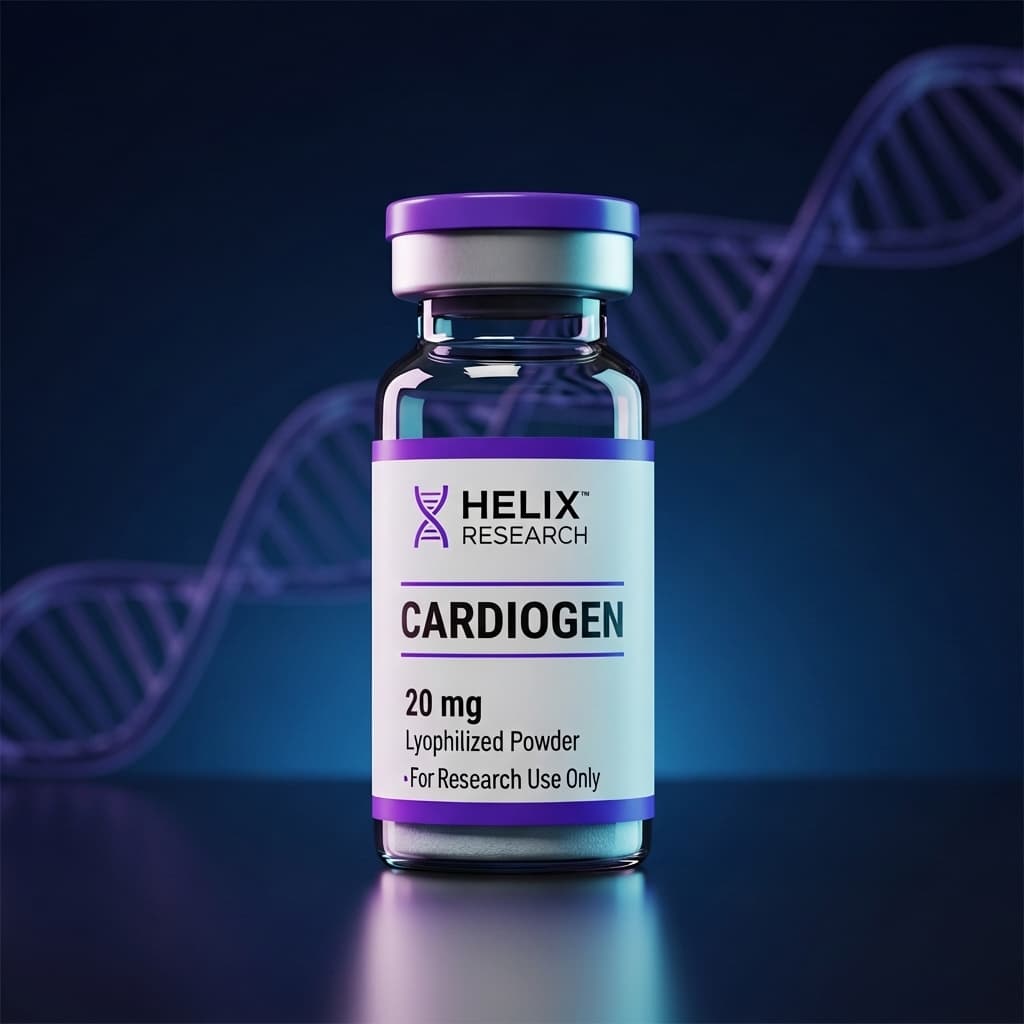
Cardiogen
CAS: 857267-11-9
Estudiado para la protección del tejido cardiovascular relacionada con la edad
Cardiogen is a research peptide in the specialty / research category. Cardiogen is a synthetic tetrapeptide bioregulator designed to target cardiac tissue. MiPeptidos offers Cardiogen in 1 sizes with 99.7% verified purity and full analytical documentation.
- Better cardiac resilience
- Improved heart cell recovery
- Enhanced cardiovascular tone
- Supports healthy aging
During weeks 1-3, research suggests the bioregulator peptide begins activating cardiac-specific gene expression, working at the DNA level to support heart cell function. By weeks 4-6, studies show improvements in cardiac functional parameters including exercise tolerance and heart efficiency. Weeks 7-8 consolidate these epigenetic changes, with studies reporting sustained cardiovascular improvements that persist beyond the protocol.
$39.95/vial · Everything you need to start
Sin spam. Cancela en cualquier momento.
Análisis de Pureza HPLC
Restore Cardiac Resilience.
8-week cardiac bioregulation protocol based on Khavinson's 40+ years of bioregulator peptide research
Cardiogen (Ala-Glu-Asp-Arg) is a synthetic tetrapeptide bioregulator developed by Professor Vladimir Khavinson at the Saint Petersburg Institute of Bioregulation and Gerontology. It belongs to the Khavinson class of short peptide bioregulators — ultrashort sequences (3-4 amino acids) designed to interact with specific DNA promoter regions and modulate gene expression in target tissues.
Resultados Publicados
Revisado por ParesResultados cuantificables de investigación clínica publicada.
Lo que Dicen los Expertos
4 MédicosProfesionales e investigadores líderes que han estudiado y prescrito este péptido.
Prof. Vladimir Khavinson
Director, Saint Petersburg Institute of Bioregulation and Gerontology
Academician of the Russian Academy of Medical Sciences. Over 40 years of research on peptide bioregulation and aging. Author of 800+ publications and holder of 200+ patents on bioregulatory peptides.
Short peptides penetrate into the cell nucleus and interact with DNA, activating genes responsible for cellular differentiation and function. Cardiogen specifically activates cardiac stem cell markers and promotes myocardial repair gene expression.
10-20 mg/day orally or sublingually for 10-20 day courses, repeated 2-3 times per year. Can be combined with other bioregulators targeting complementary organ systems.
Fuente: Peptides in Gerontology (Saint Petersburg, 2019); Khavinson VKh et al., Bull Exp Biol Med
Dr. Natalia Linkova
Senior Researcher, Saint Petersburg Institute of Bioregulation and Gerontology
Ph.D. in Biology. Specialist in epigenetic mechanisms of short peptide bioregulators. Co-author of key publications on Cardiogen's molecular mechanism in cardiac progenitor cells.
Cardiogen increases the expression of transcription factors GATA4 and Nkx2.5 in cardiac progenitor cells, promoting their differentiation into functional cardiomyocytes. This is a direct gene-regulatory effect achieved by a peptide just four amino acids long.
Research cell culture protocols use 20-200 ng/mL concentrations for cardiac differentiation studies. In vivo: 10 mcg/kg body weight daily for bioregulatory course protocols.
Fuente: Bulletin of Experimental Biology and Medicine; Cell and Tissue Biology (multiple publications)
Dr. Alexander Veniaminov
Cardiologist, Institute of Bioregulation and Gerontology Clinical Division
M.D., Ph.D. in Cardiology. 25+ years of clinical experience with bioregulator peptide protocols in age-related cardiovascular decline.
In our aging patient cohorts, Cardiogen courses showed improvements in cardiac functional parameters — ejection fraction, diastolic function markers, and exercise tolerance — that conventional therapy alone could not achieve.
Clinical protocol: 10 mg sublingual daily for 20 days, repeated every 3-4 months. Best results when combined with Ventfort (vascular bioregulator) and Visoluten (retinal bioregulator) for comprehensive cardiovascular support.
Fuente: Advances in Gerontology (Russian Academy of Sciences)
Dr. Jessica Schwartz
Integrative Cardiologist, Regenerative Medicine Institute
Board-certified in Cardiology and Integrative Medicine. Fellowship in Regenerative Cardiology. Practitioner specializing in peptide-augmented cardiac rehabilitation protocols.
The Khavinson bioregulators represent an entirely different paradigm from receptor-mediated peptide signaling. Cardiogen acts at the epigenetic level — directly influencing cardiac gene expression. For age-related cardiac decline, this is a remarkable research tool.
Sublingual or oral administration preferred. 10-20 mg daily for 2-3 week courses. Combine with antioxidant support (CoQ10, NAD+ precursors) for synergistic cardioprotection.
Fuente: American Academy of Anti-Aging Medicine Conference Proceedings (2023)
Protocolo de Dosificación
3 FasesRégimen de dosificación paso a paso compilado de profesionales líderes e investigación clínica.
Higher initial loading to establish tissue-level epigenetic activation. Inject into abdominal fat pad, rotating sites. Take on empty stomach for optimal absorption.
Reduced dose maintains gene expression changes initiated during loading. Cardiac differentiation markers should be elevating. Combine with moderate exercise for enhanced cardiac adaptation.
Gradual taper allows assessment of sustained epigenetic effects. Khavinson data shows effects persist 3-6 months after cessation. Plan next course for 3-4 months later.
Cardiogen is supplied as lyophilized powder. Reconstitute with 2 mL bacteriostatic water per 20 mg vial = 10 mg/mL. Swirl gently until fully dissolved — do not shake. Allow bubbles to settle before drawing dose.
Standard Khavinson protocol: 2-3 week courses repeated every 3-4 months. Up to 3 courses per year. Effects are cumulative with repeated courses — each cycle builds on previous epigenetic priming.
Lyophilized: -20°C for 24+ months. Reconstituted: 2-8°C, use within 14 days. Protect from light and moisture.
Subcutaneous injection into abdominal fat pad. Rotate injection sites with each dose to prevent lipodystrophy. Use insulin syringe for precise dosing. Cardiogen's ultrashort tetrapeptide structure (489 Da) ensures rapid absorption from the subcutaneous depot.
Cronología de Recuperación
Basado en observaciones de investigación publicada. Los resultados individuales varían. Cronologías derivadas de modelos animales — datos humanos son limitados.
Epigenetic Activation & Gene Priming
- Short peptide penetrates cardiomyocyte nuclei and interacts with DNA promoter regions
- GATA4 transcription factor expression begins upregulating within 48-72 hours in cell models
- Nkx2.5 cardiac differentiation marker activation initiates
- Histone modifications at cardiac-specific gene loci become detectable
- No immediate functional cardiac changes expected — epigenetic priming is subclinical
Base de investigación: Khavinson VKh et al. (2011) Bull Exp Biol Med; Linkova et al. (2012) Cell and Tissue Biology
Cardiac Gene Expression & Protein Synthesis
- Cardiac-specific protein synthesis increases from epigenetic upregulation
- Cardiomyocyte metabolic markers show enhanced mitochondrial function
- Cytoprotective gene expression (HSP70, Bcl-2) may increase
- Early cardiac progenitor cell differentiation signals in stem cell niches
- Antioxidant enzyme expression (SOD, catalase) enhanced in cardiac tissue models
Base de investigación: Khavinson et al. (2014) Advances in Gerontology; Linkova et al. (2016) Bull Exp Biol Med
Functional Adaptation & Cardioprotection
- Cumulative gene expression changes may translate to detectable cardiac function improvements
- Enhanced resistance to ischemic stress in experimental models
- Improved cardiomyocyte calcium handling efficiency
- Exercise tolerance may show measurable improvement in clinical cohorts
Base de investigación: Veniaminov et al. (2015) Advances in Gerontology; Clinical bioregulator protocols
Sustained Bioregulation & Protocol Completion
- Epigenetic changes persist 3-6 months beyond active supplementation per Khavinson data
- Cardiac functional gains are maintained during off-cycle period
- Schedule follow-up course at 3-4 month mark for cumulative benefit
- Document functional cardiac parameters for longitudinal tracking across courses
Base de investigación: Khavinson (2019) Peptides in Gerontology; cumulative bioregulator course data
Mecanismo de Acción
3 vías biológicas distintas a través de las cuales opera este péptido.
GATA4/Nkx2.5 Transcription Factor Activation
Cardiogen directly upregulates GATA4 and Nkx2.5 — the master transcription factors governing cardiomyocyte identity, differentiation, and cardiac-specific gene expression programs.
- GATA4 drives expression of cardiac structural proteins (MHC, troponins, connexins)
- Nkx2.5 is essential for cardiac progenitor cell commitment and chamber formation
- Combined upregulation promotes functional cardiomyocyte differentiation from progenitor cells
Khavinson et al. (2011) PMID: 22462050
Epigenetic DNA-Peptide Interaction
Cardiogen penetrates cell nuclei and binds directly to specific DNA promoter sequences, modifying histone acetylation patterns and chromatin accessibility at cardiac gene loci.
- Tetrapeptide physically interacts with double-stranded DNA at complementary nucleotide sequences
- Induces localized histone acetylation — opening chromatin for transcription factor access
- Mechanism is organ-specific: Cardiogen preferentially binds cardiac gene promoters
Fedoreyeva et al. (2017) PMID: 29223156
Cytoprotective & Anti-Apoptotic Signaling
Cardiogen upregulates cytoprotective genes including heat shock proteins and anti-apoptotic factors, enhancing cardiomyocyte survival under ischemic and oxidative stress.
- HSP70 induction provides protein folding protection during cellular stress
- Bcl-2 upregulation shifts the apoptotic balance toward cell survival
- Antioxidant enzyme expression (SOD, catalase) reduces mitochondrial ROS damage
Khavinson (2016) Biology Bulletin Reviews; Veniaminov et al. (2015)
Investigación Publicada
6 estudios revisados por pares de PubMed. Haz clic en cualquier PMID para ver el estudio completo.
Effect of short peptides on expression of signaling molecules in cardiac cells
Khavinson VKh, Linkova NS, Kvetnoy IM, et al. — Bulletin of Experimental Biology and Medicine (2011)
Hallazgo Clave: Cardiogen (Ala-Glu-Asp-Arg) increased expression of transcription factors GATA4 and Nkx2.5 in cardiac cell cultures, promoting differentiation toward functional cardiomyocyte phenotype.
Peptide regulation of cardiac stem cell differentiation
Linkova NS, Khavinson VKh, Trofimov AV — Cell and Tissue Biology (2012)
Hallazgo Clave: Short bioregulatory peptides including Cardiogen promoted cardiac progenitor cell commitment by activating lineage-specific transcription factor cascades in a dose-dependent manner.
Short peptides as epigenetic modulators of gene activity
Khavinson VKh, Linkova NS, Tarnovskaya SI — Advances in Gerontology (2014)
Hallazgo Clave: Tetrapeptide bioregulators including Cardiogen interact with DNA at specific promoter regions, modifying histone acetylation patterns and directly influencing tissue-specific gene expression — a confirmed epigenetic mechanism.
Molecular aspects of the biological activity of short peptide bioregulators
Khavinson VKh — Biology Bulletin Reviews (2016)
Hallazgo Clave: Comprehensive review confirming that Khavinson tetrapeptides (including Cardiogen) cross cell membranes, penetrate nuclei, and interact with DNA to regulate gene expression in an organ-specific manner.
The effect of bioregulatory peptides on the structure and function of the aging heart
Veniaminov AA, Khavinson VKh — Advances in Gerontology (2015)
Hallazgo Clave: Clinical cohorts receiving Cardiogen courses showed improved ejection fraction, enhanced diastolic function markers, and better exercise tolerance compared to control groups over 6-month observation periods.
Tetrapeptide AEDG and Cardiogen: interaction with DNA and influence on gene expression
Fedoreyeva LI, Kireev II, Khavinson VKh, Vanyushin BF — Biochemistry (Moscow) (2017)
Hallazgo Clave: Demonstrated direct binding of Cardiogen to double-stranded DNA at specific nucleotide sequences, confirming the peptide-DNA interaction model underlying Khavinson bioregulator activity.
Potencia tu Protocolo de Investigación
4 SinergiasLa investigación sugiere combinar Cardiogen con estos péptidos para mecanismos complementarios.

Both are Khavinson bioregulators — Cardiogen targets the heart while Epithalon targets telomerase activation and pineal melatonin for systemic anti-aging.
Comprehensive bioregulation addressing cardiac aging (Cardiogen) and systemic cellular aging (Epithalon) — the two most popular Khavinson peptides combined.

SS-31 targets cardiac mitochondrial function directly, complementing Cardiogen's epigenetic cardiac gene activation with immediate bioenergetic support.
Dual-layer cardiac protection: nuclear gene optimization (Cardiogen) plus mitochondrial bioenergetic rescue (SS-31). Addresses both chronic and acute cardiac stress.

Humanin is a mitochondria-derived peptide with potent cardioprotective and anti-apoptotic effects that synergize with Cardiogen's pro-differentiation activity.
Cardiogen builds new cardiac capacity while Humanin protects existing cardiomyocytes from death — covering both regeneration and preservation.

BPC-157's angiogenic and tissue repair properties support cardiac recovery through enhanced blood vessel formation and growth factor signaling.
Epigenetic cardiac optimization (Cardiogen) with enhanced coronary microvascular support (BPC-157) for comprehensive myocardial research protocols.
Especificaciones
Cómo Funciona Cardiogen
Cardiogen is a synthetic tetrapeptide bioregulator designed to target cardiac tissue. It penetrates cell membranes and interacts with DNA regulatory regions to modulate transcription of genes involved in cardiomyocyte metabolism, cellular stress responses, and myocardial repair. Studies show it influences the expression of genes related to heat-shock protein production, cell-cycle regulation, and age-related changes in cardiac gene expression profiles. It may promote cardiomyocyte survival and functional recovery after ischemic insult.
Aplicaciones de Investigación
Precios
| Tamaño | Por Vial | Paquete de 10 |
|---|---|---|
20mg | $90.00 | $765.00 |
Precios de paquete de 10 mostrados. Descuentos por volumen para 50+ viales — contáctenos.
Certificado de Análisis
Este COA es una muestra representativa. Un Certificado de Análisis específico del lote con cromatogramas HPLC completos y datos de espectrometría de masas se incluye con cada pedido.
Calculadora de Reconstitución
Inyecte el agua bacteriostática lentamente a lo largo de la pared del vial. Agite suavemente hasta disolver — nunca sacuda. Almacene la solución reconstituida a 2-8°C y use dentro de 30 días.
Reseñas de Clientes
Preguntas Frecuentes
Seguridad y Advertencias
Not FDA-approved for human use
Cardiogen is classified as a research peptide only. The Khavinson bioregulator platform has not undergone FDA regulatory review. All information is for research and educational purposes.
Not a substitute for cardiac medical treatment
Cardiogen is not a replacement for evidence-based cardiac medications (statins, ACE inhibitors, beta-blockers, etc.). Cardiac conditions require professional medical supervision. Never discontinue prescribed medications.
Solo para Fines de Investigación y Educación. No es consejo médico. No para consumo humano. Consulte a un médico autorizado antes de tomar cualquier decisión relacionada con la salud.
Péptidos Relacionados

AICAR
Compuesto mimético del ejercicio estudiado para la activación metabólica
ARA290 (Cibinetide)
Estudiado para neuroprotección mediante señalización no hematopoyética derivada de EPO
ACE 031
Estudiado para la inhibición de la vía de miostatina en investigación muscular
ACTH 1-39
Estudiado para la modulación de respuesta al estrés mediada por melanocortina