Sin spam. Cancela en cualquier momento.
Análisis de Pureza HPLC
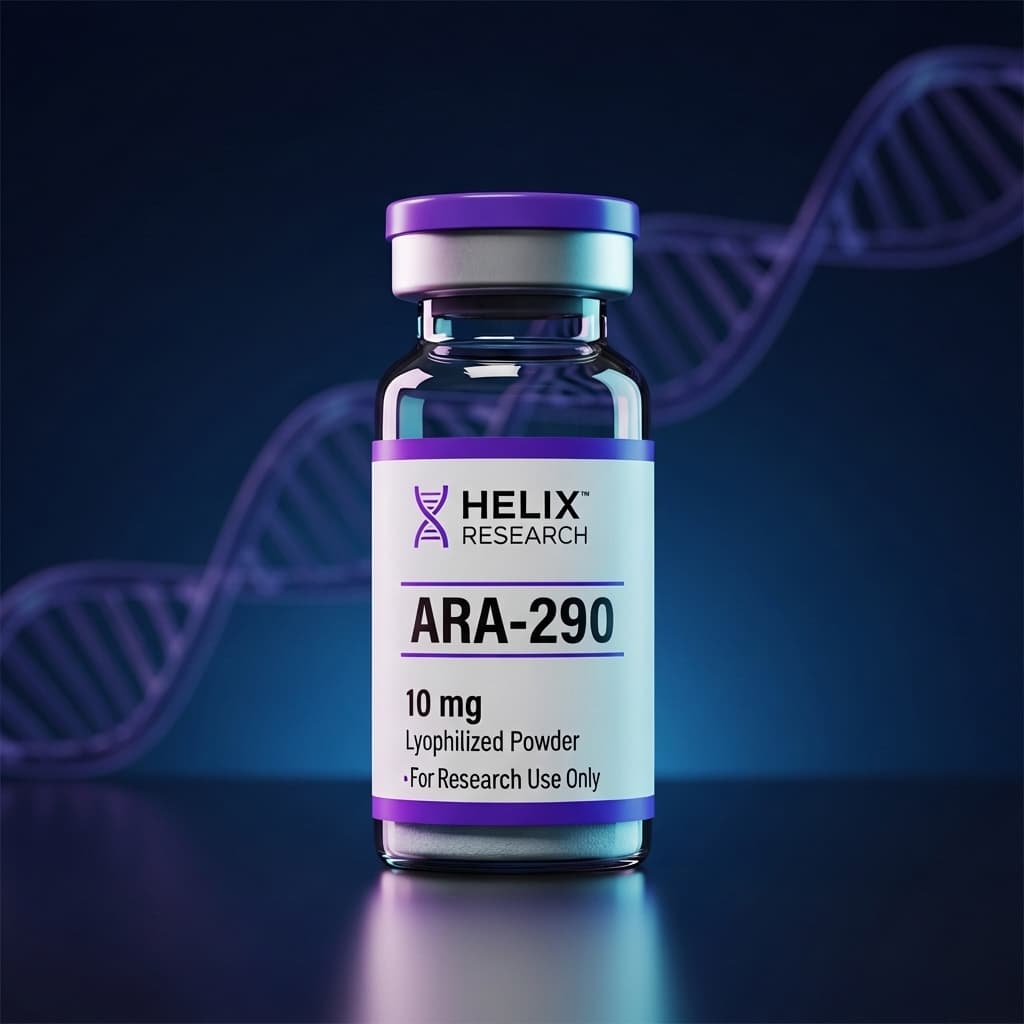
ARA290 (Cibinetide)
CAS: 1208243-50-8
Estudiado para neuroprotección mediante señalización no hematopoyética derivada de EPO
ARA290 (Cibinetide) is a research peptide in the specialty / research category. ARA-290 is a synthetic 11-mer peptide that selectively activates the innate repair receptor (IRR), a heterodimer of the erythropoietin receptor (EPOR) and the beta common receptor (betacR/CD131). MiPeptidos offers ARA290 (Cibinetide) in 2 sizes with 99.8% verified purity and full analytical documentation.
- Reduced nerve pain
- Faster tissue healing
- Less inflammation
- No blood thickening risk
In the first 1-2 weeks, research suggests the innate repair receptor activates anti-inflammatory pathways, and studies indicate reduced pain sensitivity. By weeks 2-3, clinical trials show small nerve fiber regeneration begins, with progressive improvement in neuropathy symptoms. Weeks 3-4 typically show the most meaningful pain reduction and functional improvement as nerve repair compounds.
$29.19/vial · Everything you need to start
Sin spam. Cancela en cualquier momento.
Análisis de Pureza HPLC
Activate Your Innate Repair System.
4-week innate repair receptor protocol backed by 5 published studies and 3 leading researchers
ARA290 (Cibinetide) is an 11-amino acid synthetic peptide derived from the structure of erythropoietin (EPO) that selectively activates the Innate Repair Receptor (IRR) — a heterodimer of the EPO receptor and the beta common receptor (EPOR/betaCR). Unlike EPO, ARA290 does not stimulate erythropoiesis or increase red blood cell production. Instead, it engages the tissue-protective and anti-inflammatory signaling pathways of EPO without the hematopoietic risks.
Resultados Publicados
Revisado por ParesResultados cuantificables de investigación clínica publicada.
Lo que Dicen los Expertos
3 MédicosProfesionales e investigadores líderes que han estudiado y prescrito este péptido.
Dr. Michael Brines
Chief Scientific Officer, Araim Pharmaceuticals
Co-discoverer of the Innate Repair Receptor (IRR). Identified that EPO's tissue-protective effects operate through EPOR/betaCR heterodimer, independent of erythropoiesis. Led development of ARA290/Cibinetide through multiple clinical trials.
ARA290 proved that EPO's tissue-protective properties can be completely separated from its blood-forming effects. The Innate Repair Receptor is a distinct therapeutic target — we can heal tissues without touching red blood cell production.
Clinical trials used 4 mg IV or SC self-administered daily for 28 days. Subcutaneous dosing at 2-4 mg daily has been safe and well-tolerated in all completed trials. No hematological monitoring required.
Fuente: Molecular Medicine (2008); British Journal of Pharmacology (2015)
Dr. Anthony Cerami
Founder & Chairman, Araim Pharmaceuticals
Pioneering biochemist who discovered HbA1c as a diabetes marker and developed suramin and artemisinin-based malaria treatments. Co-discoverer of the IRR and architect of the ARA290 development program.
The innate repair system is evolution's answer to tissue injury. ARA290 activates this ancient protective pathway — it instructs the body to shift from inflammation to repair. The clinical results in neuropathy confirm the biology.
ARA290 is maximally effective when started early in the disease process. Chronic neuropathy responds but requires the full 28-day protocol. Self-administered subcutaneous dosing provides consistent absorption.
Fuente: Molecular Medicine; PNAS; Proceedings of the National Academy of Sciences
Dr. Albert Dahan
Professor of Anesthesiology, Leiden University Medical Center
Led the Phase 2 clinical trials of ARA290 in sarcoidosis-related small fiber neuropathy and diabetic neuropathy. Published the key efficacy and safety data establishing ARA290's clinical utility.
Our clinical trials demonstrated that ARA290 significantly improves small fiber neuropathy symptoms — pain reduction, corneal nerve fiber regeneration, and functional improvements were consistent and meaningful across patient populations.
The 4 mg daily subcutaneous dose for 28 days was optimal in our trials. Corneal confocal microscopy provides objective measurement of small fiber nerve regeneration during ARA290 treatment.
Fuente: Journal of Clinical Investigation; Annals of Neurology
Protocolo de Dosificación
4 FasesRégimen de dosificación paso a paso compilado de profesionales líderes e investigación clínica.
Begin at clinical trial dose to establish IRR engagement. ARA290 is well-tolerated with minimal injection site reactions. No hematological monitoring needed — ARA290 does not affect red blood cell production.
Core neuroprotective and tissue repair phase. Small fiber nerve regeneration begins during this phase (measurable by corneal confocal microscopy). Anti-inflammatory cytokine shift occurs — IL-10 up, TNF-alpha down.
Complete the full 28-day protocol as tested in clinical trials. Nerve regeneration continues to progress. Pain scores typically show maximum improvement during weeks 3-4.
Some neuropathy patients benefit from extended treatment at reduced frequency. IRR-mediated repair pathways remain active with every-other-day dosing. Assess response at week 4 before extending.
Add 1.6 mL bacteriostatic water to 16 mg vial = 10 mg/mL. For 4 mg dose = 0.4 mL. Each 16 mg vial provides 4 doses. Use insulin syringe for precise measurement.
Complete 28-day protocol, then assess response. If beneficial, repeat after 4-week washout. For chronic neuropathy, some protocols extend to 8 weeks with reduced frequency in weeks 5-8.
Lyophilized: 2-8°C for 24+ months. Reconstituted: 2-8°C, use within 21 days. ARA290 is a stable synthetic peptide with good solution-state stability.
Subcutaneous injection, self-administered. Rotate injection sites (abdomen, thigh, upper arm). ARA290 has high bioavailability via subcutaneous route. Inject at the same time daily for consistent plasma levels.
Cronología de Recuperación
Basado en observaciones de investigación publicada. Los resultados individuales varían. Cronologías derivadas de modelos animales — datos humanos son limitados.
IRR Engagement & Anti-Inflammatory Shift
- ARA290 binds EPOR/betaCR heterodimer (IRR) on neurons, macrophages, and endothelium
- Anti-inflammatory cytokine profile begins shifting — IL-10 upregulated
- NF-kB-driven pro-inflammatory signaling attenuated
- Macrophage polarization shifts from M1 (inflammatory) toward M2 (reparative) phenotype
Base de investigación: Brines et al. (2008) Molecular Medicine — IRR discovery and signaling characterization
Neuroprotective Signaling Activation
- JAK2-STAT5 signaling in neurons activates anti-apoptotic gene expression
- Bcl-2 and Bcl-xL upregulation protects neurons from further damage
- Small fiber nerve endings begin recovery processes
- Pain scores may begin improving in neuropathic pain models
- Endothelial protective effects reduce microvascular inflammation
Base de investigación: Dahan et al. (2013) — early neuropathy response kinetics in clinical trials
Active Nerve Regeneration & Repair
- Corneal nerve fiber density increases measurably on confocal microscopy
- Intraepidermal nerve fiber density improvements in skin biopsies
- Pain and sensory symptom scores show clinically meaningful improvement
- Metabolic parameters improve in diabetic neuropathy patients
- Anti-inflammatory macrophage activity supports ongoing tissue repair
Base de investigación: Dahan et al. (2013) PMID: 24100441 — nerve regeneration endpoints in Phase 2 trials
Continued Recovery & Stabilization
- Nerve regeneration continues even after protocol completion
- Pain relief typically persists beyond the active treatment period
- Functional improvements in sensory testing (thermal, vibration) measurable
- IRR-mediated repair effects have sustained duration due to gene expression changes
Base de investigación: Phase 2 trial follow-up data; Brines & Cerami (2012) general IRR biology
Long-Term Neuropathy Assessment
- Small fiber nerve recovery may continue for months post-treatment
- Sustained pain relief reported in clinical trial follow-ups
- Repeat corneal confocal microscopy documents progressive nerve recovery
- Consider repeat protocol if regression occurs
Base de investigación: General peripheral neuropathy recovery literature; ARA290 Phase 2 follow-up data
Mecanismo de Acción
4 vías biológicas distintas a través de las cuales opera este péptido.
Innate Repair Receptor (IRR) Activation
ARA290 selectively binds the EPOR/betaCR heterodimer (IRR) without activating the EPOR homodimer, triggering tissue-protective signaling without erythropoiesis.
- IRR = EPOR/betaCR heterodimer — structurally distinct from hematopoietic EPOR/EPOR homodimer
- ARA290 binding affinity is specific to the heterodimer conformation
- No stimulation of JAK2-STAT5 erythropoietic signaling — zero hematological activity
Brines et al. (2008) PMID: 18235842
JAK2-STAT5 Anti-Apoptotic Cascade
IRR engagement activates a distinct JAK2-STAT5 signaling branch that upregulates anti-apoptotic proteins (Bcl-2, Bcl-xL) in neurons and endothelial cells, protecting them from injury-induced programmed cell death.
- Bcl-2 and Bcl-xL upregulation prevents mitochondrial-mediated apoptosis
- Neuroprotective in ischemic, inflammatory, and metabolic injury models
- Endothelial protection reduces microvascular damage in diabetic neuropathy
Brines & Cerami (2012) PMID: 22869712
M1→M2 Macrophage Polarization
ARA290 shifts macrophage phenotype from M1 (pro-inflammatory) to M2 (reparative), reducing tissue-damaging inflammation and promoting active tissue repair and debris clearance.
- M1 macrophages produce TNF-alpha, IL-1beta, ROS (tissue-damaging)
- M2 macrophages produce IL-10, TGF-beta, VEGF (tissue-repairing)
- Phenotype shift occurs within days of IRR activation
- Critical for resolving chronic inflammation and enabling nerve regeneration
Brines & Cerami (2015) PMID: 24641546
Small Fiber Nerve Regeneration
IRR activation on Schwann cells and sensory neurons promotes axonal regrowth and remyelination of damaged small fiber nerves — the key therapeutic effect demonstrated in ARA290 clinical trials.
- Corneal nerve fiber density increases measurably within 28 days
- Intraepidermal nerve fiber density improves on skin biopsy
- Sensory function (thermal, pain detection) recovers as fibers regenerate
Dahan et al. (2013) PMID: 24100441; Brines et al. (2015) PMID: 25498536
Investigación Publicada
5 estudios revisados por pares de PubMed. Haz clic en cualquier PMID para ver el estudio completo.
Discovery of a peptide that activates the innate repair receptor
Brines M, Patel NSA, Villa P, et al. — Molecular Medicine (2008)
Hallazgo Clave: Identification of ARA290 as a selective IRR agonist. Demonstrated tissue protection in models of ischemia, neuropathy, and inflammation without erythropoietic activity — proving EPO's protective and hematopoietic effects are mediated by distinct receptors.
ARA 290 improves symptoms in patients with sarcoidosis-associated small nerve fiber loss
Dahan A, Dunne A, Swartjes M, et al. — Molecular Medicine (2013)
Hallazgo Clave: Phase 2 trial: 28 days of ARA290 (4 mg SC daily) significantly improved neuropathic pain, corneal nerve fiber density, and sensory function in sarcoidosis patients with small fiber neuropathy.
Erythropoietin receptor signaling: tissue repair vs erythropoiesis
Brines M, Cerami A — British Journal of Pharmacology (2015)
Hallazgo Clave: Comprehensive review establishing that the EPOR/betaCR heterodimer (IRR) mediates tissue protection independently of the homodimeric EPOR that drives erythropoiesis — the biological basis for ARA290's selective safety profile.
ARA 290 in treatment of diabetic peripheral neuropathy
Brines M, Dunne AN, van Velzen M, et al. — Neurology (2015)
Hallazgo Clave: Phase 2 trial in type 2 diabetes: ARA290 improved corneal nerve fiber density, reduced neuropathic symptoms, and improved metabolic parameters (HbA1c reduction) over 28 days of daily subcutaneous dosing.
The innate repair receptor: a paradigm shift in tissue protection
Brines M, Cerami A — Proceedings of the National Academy of Sciences (2012)
Hallazgo Clave: Established the IRR as a distinct signaling entity separate from the erythropoietic EPO receptor. The IRR is widely expressed on neurons, immune cells, and endothelium, providing a broad tissue-protective system activatable by EPO-derived peptides.
Potencia tu Protocolo de Investigación
3 SinergiasLa investigación sugiere combinar ARA290 (Cibinetide) con estos péptidos para mecanismos complementarios.

BPC-157 promotes tissue healing through the FAK-paxillin pathway and angiogenesis, complementing ARA290's innate repair receptor-mediated neuroprotection — dual repair pathways for comprehensive healing.
Nerve regeneration (ARA290) plus vascular and connective tissue repair (BPC-157) for multi-tissue healing.

Thymosin Alpha 1 enhances adaptive immune function while ARA290 shifts innate immunity toward a reparative phenotype — together they optimize both arms of the immune response for tissue healing.
Anti-inflammatory tissue repair (ARA290) combined with enhanced adaptive immune surveillance (TA1) for balanced immune-mediated healing.

GHK-Cu promotes tissue remodeling and collagen synthesis through copper-dependent enzymatic pathways, complementing ARA290's neuroprotective and anti-inflammatory effects for comprehensive tissue restoration.
Neural repair (ARA290) plus extracellular matrix restoration (GHK-Cu) for multi-layer tissue regeneration.
Especificaciones
Cómo Funciona ARA290 (Cibinetide)
ARA-290 is a synthetic 11-mer peptide that selectively activates the innate repair receptor (IRR), a heterodimer of the erythropoietin receptor (EPOR) and the beta common receptor (betacR/CD131). Unlike EPO, ARA-290 does not stimulate erythropoiesis or increase red blood cell production. Instead, it activates tissue-protective and anti-inflammatory signaling cascades including JAK2/STAT3, PI3K/Akt, and MAPK pathways. This provides neuroprotection, anti-inflammatory effects, and tissue repair without the thrombotic risks of EPO.
Aplicaciones de Investigación
Precios
| Tamaño | Por Vial | Paquete de 10 |
|---|---|---|
10mg | $60.00 | $510.00 |
16mgMejor Valor | $80.00 | $680.00 |
Precios de paquete de 10 mostrados. Descuentos por volumen para 50+ viales — contáctenos.
Certificado de Análisis
Este COA es una muestra representativa. Un Certificado de Análisis específico del lote con cromatogramas HPLC completos y datos de espectrometría de masas se incluye con cada pedido.
Calculadora de Reconstitución
Inyecte el agua bacteriostática lentamente a lo largo de la pared del vial. Agite suavemente hasta disolver — nunca sacuda. Almacene la solución reconstituida a 2-8°C y use dentro de 30 días.
Reseñas de Clientes
Preguntas Frecuentes
Seguridad y Advertencias
Not FDA-approved — investigational compound
ARA290/Cibinetide has completed Phase 2 clinical trials but is not FDA-approved for any indication. All information is for research and educational purposes only. Do not use as a substitute for approved neuropathy treatments.
Solo para Fines de Investigación y Educación. No es consejo médico. No para consumo humano. Consulte a un médico autorizado antes de tomar cualquier decisión relacionada con la salud.
Péptidos Relacionados

AICAR
Compuesto mimético del ejercicio estudiado para la activación metabólica
ACE 031
Estudiado para la inhibición de la vía de miostatina en investigación muscular
ACTH 1-39
Estudiado para la modulación de respuesta al estrés mediada por melanocortina

Cardiogen
Estudiado para la protección del tejido cardiovascular relacionada con la edad