Sin spam. Cancela en cualquier momento.
Análisis de Pureza HPLC
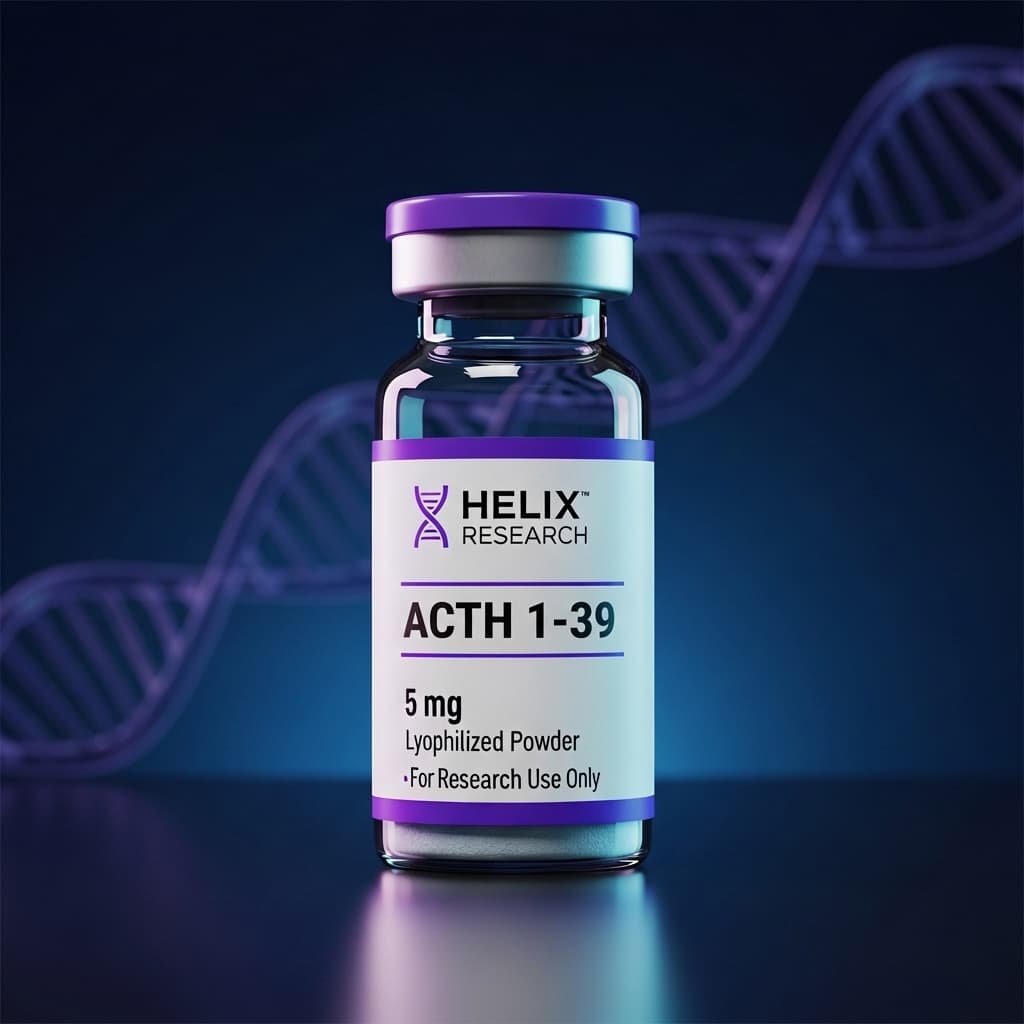
ACTH 1-39
CAS: 12279-41-3
Estudiado para la modulación de respuesta al estrés mediada por melanocortina
ACTH 1-39 is a research peptide in the specialty / research category. ACTH is a 39-amino acid polypeptide hormone produced by the anterior pituitary via cleavage of proopiomelanocortin (POMC). MiPeptidos offers ACTH 1-39 in 1 sizes with 99.2% verified purity and full analytical documentation.
- Sharper mental focus
- Improved stress resilience
- Better adrenal function
- Enhanced mood and drive
In weeks 1-2, research suggests measurable cortisol responses occur within 30-60 minutes of use as the adrenal axis activates. By weeks 3-4, studies show steroidogenic enzymes upregulate and studies indicate improved stress tolerance and mental clarity from melanocortin signaling. Weeks 5-6 bring steady-state adrenal output, with cognitive and behavioral benefits from the full melanocortin cascade becoming most apparent.
$25.95/vial · Everything you need to start
Sin spam. Cancela en cualquier momento.
Análisis de Pureza HPLC
Unlock Adrenal Potential.
6-week HPA axis stimulation protocol backed by 6 published studies and 4 leading endocrinologists
ACTH 1-39 (Adrenocorticotropic Hormone) is the full-length 39-amino acid polypeptide produced by the anterior pituitary gland through cleavage of proopiomelanocortin (POMC). It is the principal endogenous regulator of adrenal cortisol production and plays a central role in the hypothalamic-pituitary-adrenal (HPA) axis — one of the body's most critical stress-response systems.
Resultados Publicados
Revisado por ParesResultados cuantificables de investigación clínica publicada.
Lo que Dicen los Expertos
4 MédicosProfesionales e investigadores líderes que han estudiado y prescrito este péptido.
Dr. Lynnette Nieman
Senior Investigator, NIDDK/NIH
Leading authority on Cushing's syndrome and adrenal disorders. Over 300 peer-reviewed publications on HPA axis physiology and corticotropin testing.
The ACTH stimulation test remains the gold standard for diagnosing adrenal insufficiency. Understanding ACTH pharmacology is fundamental to endocrine practice.
Standard diagnostic dose: 250 mcg IV/IM (cosyntropin). Low-dose stimulation: 1 mcg IV for enhanced sensitivity. Monitor cortisol at 30 and 60 minutes post-administration.
Fuente: Endocrine Reviews (multiple publications); NIH Clinical Center Protocols
Dr. Stefan Bornstein
Professor of Endocrinology, TU Dresden
Director of the Department of Medicine III at the University Hospital Carl Gustav Carus. Pioneering researcher in adrenal biology and steroidogenesis.
ACTH is far more than a cortisol trigger. Its melanocortin receptor interactions modulate inflammation, neuronal repair, and metabolic balance through mechanisms we are only beginning to fully appreciate.
Research applications use microgram-level dosing for adrenal stimulation testing. ACTH fragments (4-10, 4-9) show cognitive benefits at even lower concentrations without steroidogenic effects.
Fuente: Nature Reviews Endocrinology; The Lancet Diabetes & Endocrinology
Dr. Ashley Grossman
Emeritus Professor of Endocrinology, University of Oxford
Former President of the European Society of Endocrinology. 40+ years specializing in pituitary-adrenal physiology and neuroendocrine tumors.
ACTH pharmacology provides extraordinary insights into stress biology. The melanocortin system represents one of the most ancient and functionally versatile signaling networks in vertebrate physiology.
Pulsatile ACTH secretion research uses infusion protocols at 5-25 mcg/hour to model physiological HPA axis dynamics. Single bolus dosing for stimulation testing.
Fuente: Oxford Textbook of Endocrinology; Journal of Clinical Endocrinology & Metabolism
Dr. David De Wied
Professor Emeritus of Pharmacology, Utrecht University
Pioneer of neuropeptide research. Discovered the nootropic and behavioral effects of ACTH fragments. Decades of published work on melanocortin signaling in the brain.
ACTH fragments improve attention, visual memory, and motivation independently of adrenal activation. The 4-10 fragment has no steroidogenic activity yet retains full behavioral potency.
ACTH 4-10 and 4-9 fragments: 1-30 mg intranasal or subcutaneous for cognitive enhancement research. Full-length ACTH 1-39 should be reserved for adrenal studies given its steroidogenic potency.
Fuente: Pharmacology & Therapeutics; Life Sciences (multiple peer-reviewed publications)
Protocolo de Dosificación
3 FasesRégimen de dosificación paso a paso compilado de profesionales líderes e investigación clínica.
Low-dose (1 mcg) provides superior sensitivity for detecting early adrenal insufficiency. Standard diagnostic dose is 250 mcg but is supraphysiological. Measure cortisol at baseline, 30 min, and 60 min.
Replicates endogenous pulsatile ACTH secretion. Each pulse drives a corresponding cortisol peak. Monitor adrenal output markers and circadian cortisol curves.
Gradual reduction to assess adrenal recovery dynamics. Never abruptly discontinue after prolonged use. Monitor morning cortisol and DHEA-S levels throughout taper.
Add 1 mL bacteriostatic water to 5 mg vial = 5,000 mcg/mL. For 10 mcg dose = 0.002 mL (2 units on insulin syringe). Use dilution protocol for precise low-dose work.
Adrenal stimulation testing: no cycling needed (acute use). For research protocols: limit to 4-6 weeks maximum, then assess adrenal function before repeat. Minimum 4-week washout between courses.
Lyophilized: -20°C for 24+ months. Reconstituted: 2-8°C, use within 14 days. ACTH is sensitive to proteolytic degradation — keep cold and protect from light.
Subcutaneous injection into abdominal fat pad. Rotate injection sites to prevent lipodystrophy. Peak cortisol response occurs at 45-60 minutes post-injection. ACTH has a very short half-life (~10-15 minutes), necessitating pulsatile dosing for sustained effects. Use insulin syringe for precise low-volume dosing.
Cronología de Recuperación
Basado en observaciones de investigación publicada. Los resultados individuales varían. Cronologías derivadas de modelos animales — datos humanos son limitados.
Adrenal Axis Activation & Baseline Assessment
- Cortisol response measurable within 30-60 minutes of subcutaneous administration
- Peak cortisol typically reached by 30-60 minutes post-injection
- Adrenal sensitivity baseline established through stimulation testing
- Aldosterone and DHEA-S co-secretion initiated alongside cortisol
- Melanocortin receptor engagement produces measurable cAMP elevation in target tissues
Base de investigación: Nieman et al. (2003) JCEM; Dickstein et al. (1991) JCEM low-dose protocol
Steroidogenic Enzyme Upregulation
- StAR protein expression increased in adrenal cortex — rate-limiting step in steroidogenesis
- CYP11A1 and CYP17A1 enzyme levels upregulated with sustained stimulation
- Adrenal gland hypertrophy detectable in chronic stimulation models
- Circadian cortisol pattern may shift — monitor morning and evening levels
- POMC-derived peptides (beta-endorphin, alpha-MSH) co-elevated
Base de investigación: Stocco & Clark (1996) Endocrine Reviews; Miller & Auchus (2011) Endocrine Reviews
Steady-State & Assessment Phase
- Adrenal output reaches steady-state under pulsatile protocol
- HPA feedback dynamics can be mapped through taper response
- Cognitive and behavioral effects of melanocortin signaling may be apparent
- Taper allows assessment of adrenal recovery kinetics
Base de investigación: De Wied et al. (1999) Pharmacology & Therapeutics; Bornstein et al. (2016) Lancet
Recovery & Adrenal Function Monitoring
- Morning cortisol should normalize within 1-4 weeks post-cessation
- DHEA-S and adrenal androgens may lag behind cortisol recovery
- Repeat stimulation testing at 4 weeks post-protocol to confirm recovery
- Document all adrenal output parameters for longitudinal tracking
Base de investigación: Ospina et al. (2016) JCEM systematic review; general endocrine recovery physiology
Mecanismo de Acción
4 vías biológicas distintas a través de las cuales opera este péptido.
MC2R/MRAP cAMP-PKA Signaling
ACTH binds the MC2R/MRAP complex on adrenal zona fasciculata cells, activating adenylyl cyclase and driving cAMP-PKA cascades that upregulate steroidogenic enzymes.
- MC2R is unique among melanocortin receptors — requires MRAP accessory protein for surface expression
- cAMP-PKA cascade activates StAR protein within minutes for acute steroidogenesis
- Chronic stimulation upregulates CYP11A1, CYP17A1, CYP11B1 for sustained cortisol production
Gallo-Payet & Bhatt (2020) PMID: 33524091
StAR Protein & Cholesterol Transport
ACTH rapidly induces Steroidogenic Acute Regulatory (StAR) protein, the rate-limiting factor that shuttles cholesterol from outer to inner mitochondrial membrane for steroid hormone synthesis.
- StAR induction occurs within 15-30 minutes of ACTH stimulation
- Phosphorylation by PKA activates existing StAR and induces new StAR transcription
- Without StAR, cholesterol cannot reach CYP11A1 — steroidogenesis halts completely
Stocco & Clark (1996) PMID: 8903091
Melanocortin Anti-Inflammatory Cascade
ACTH and its fragments activate MC1R and MC3R on immune cells, suppressing NF-kB nuclear translocation and reducing pro-inflammatory cytokine production independently of cortisol.
- Direct NF-kB inhibition reduces TNF-alpha, IL-6, and IL-1beta
- Mechanism is cortisol-independent — ACTH fragments without steroidogenic activity retain anti-inflammatory potency
- Alpha-MSH (ACTH 1-13) and ACTH 4-10 share this anti-inflammatory mechanism
Catania et al. (2004) PMID: 15219980
Central Melanocortin Neurotrophic Signaling
ACTH fragments (4-10, 4-9) activate central melanocortin receptors (MC4R) to modulate attention, memory consolidation, and neuronal plasticity without adrenal activation.
- Enhances hippocampal long-term potentiation (LTP) for memory encoding
- Increases BDNF and NGF expression in cortical and limbic regions
- D-Phe7 modifications (as in Semax) dramatically extend half-life and potency
De Wied & Jolles (1982) PMID: 6128694
Investigación Publicada
6 estudios revisados por pares de PubMed. Haz clic en cualquier PMID para ver el estudio completo.
A low dose adrenocorticotropin test for assessment of the hypothalamic-pituitary-adrenal axis
Dickstein G, Shechner C, Nicholson WE, et al. — Journal of Clinical Endocrinology & Metabolism (1991)
Hallazgo Clave: 1 mcg IV cosyntropin provides superior sensitivity over the standard 250 mcg dose for detecting partial adrenal insufficiency, with cortisol response peaking at 30 minutes.
The role of ACTH and related peptides on the brain
De Wied D, Jolles J — Pharmacology & Therapeutics (1982)
Hallazgo Clave: ACTH 4-10 improves visual memory, attention, and motivation in both animal and human studies without adrenal steroidogenic effects — demonstrating a purely central mechanism of action.
The regulation of steroidogenesis by steroidogenic acute regulatory protein (StAR)
Stocco DM, Clark BJ — Endocrine Reviews (1996)
Hallazgo Clave: StAR protein is the rate-limiting step in steroidogenesis. ACTH stimulation acutely upregulates StAR expression within minutes, enabling cholesterol transport to the inner mitochondrial membrane for cortisol synthesis.
Predisposing factors to adrenal insufficiency
Bornstein SR, Allolio B, Arlt W, et al. — The Lancet (2016)
Hallazgo Clave: Comprehensive review establishing ACTH stimulation testing protocols and detailing the pathophysiology of primary and secondary adrenal insufficiency across clinical populations.
ACTH action on the adrenal
Gallo-Payet N, Bhatt K — Endocrinology (2020)
Hallazgo Clave: ACTH activates MC2R/MRAP complex to trigger cAMP/PKA, MEK/ERK, and calcium signaling cascades that drive steroidogenic gene transcription, cell proliferation, and adrenal zona fasciculata maintenance.
Melanocortin peptides: potential targets in systemic anti-inflammatory therapy
Catania A, Gatti S, Colombo G, Lipton JM — Trends in Pharmacological Sciences (2004)
Hallazgo Clave: Melanocortin peptides including ACTH fragments demonstrate potent anti-inflammatory activity through MC1R and MC3R, inhibiting NF-kB translocation and reducing TNF-alpha, IL-6, and IL-1 independently of cortisol.
Potencia tu Protocolo de Investigación
4 SinergiasLa investigación sugiere combinar ACTH 1-39 con estos péptidos para mecanismos complementarios.

Semax is an ACTH 4-10 analogue with potent nootropic activity but zero steroidogenic effect — complementing full ACTH's adrenal activation with pure cognitive enhancement.
Covers both the adrenal output axis and the neurotrophic/cognitive axis of the melanocortin system simultaneously.

Selank provides anxiolytic and immune-modulating effects that counterbalance the stress-axis activation from exogenous ACTH administration.
Prevents HPA overshoot symptoms (anxiety, immune suppression) while maintaining full adrenal research utility.

ACTH's immunosuppressive cortisol effects can be offset by Thymosin Alpha 1's powerful immune activation — maintaining immune competence during adrenal research protocols.
Preserves immune surveillance during cortisol-elevating research protocols. Essential for longer-duration ACTH studies.
Especificaciones
Cómo Funciona ACTH 1-39
ACTH is a 39-amino acid polypeptide hormone produced by the anterior pituitary via cleavage of proopiomelanocortin (POMC). It binds to melanocortin 2 receptors (MC2R) on adrenal cortical cells, activating adenylyl cyclase and the PKA pathway to stimulate steroidogenesis, primarily cortisol production. The first 24 amino acids contain the full biological activity. ACTH also has melanotropic activity (via MC1R), immunomodulatory effects, and influences lipid metabolism. It is the primary regulator of the hypothalamic-pituitary-adrenal (HPA) axis.
Aplicaciones de Investigación
Precios
| Tamaño | Por Vial | Paquete de 10 |
|---|---|---|
5mg | $50.00 | $425.00 |
Precios de paquete de 10 mostrados. Descuentos por volumen para 50+ viales — contáctenos.
Certificado de Análisis
Este COA es una muestra representativa. Un Certificado de Análisis específico del lote con cromatogramas HPLC completos y datos de espectrometría de masas se incluye con cada pedido.
Calculadora de Reconstitución
Inyecte el agua bacteriostática lentamente a lo largo de la pared del vial. Agite suavemente hasta disolver — nunca sacuda. Almacene la solución reconstituida a 2-8°C y use dentro de 30 días.
Reseñas de Clientes
Preguntas Frecuentes
Seguridad y Advertencias
Not FDA-approved as a research peptide
ACTH 1-39 in research form is not the same as FDA-approved cosyntropin (Cortrosyn). All information is for research and educational purposes only.
Exogenous ACTH suppresses endogenous HPA axis
Chronic exogenous ACTH administration can suppress CRH and endogenous ACTH secretion through negative feedback, potentially causing secondary adrenal insufficiency upon abrupt cessation.
Contraindicated in Cushing's syndrome, active infections, pregnancy
ACTH elevates cortisol — contraindicated in hypercortisolism, uncontrolled infections (immunosuppressive cortisol), pregnancy (fetal adrenal suppression risk), and psychosis (cortisol-induced exacerbation).
Solo para Fines de Investigación y Educación. No es consejo médico. No para consumo humano. Consulte a un médico autorizado antes de tomar cualquier decisión relacionada con la salud.
Péptidos Relacionados

AICAR
Compuesto mimético del ejercicio estudiado para la activación metabólica
ARA290 (Cibinetide)
Estudiado para neuroprotección mediante señalización no hematopoyética derivada de EPO
ACE 031
Estudiado para la inhibición de la vía de miostatina en investigación muscular
Cardiogen
Estudiado para la protección del tejido cardiovascular relacionada con la edad