Sin spam. Cancela en cualquier momento.
Análisis de Pureza HPLC
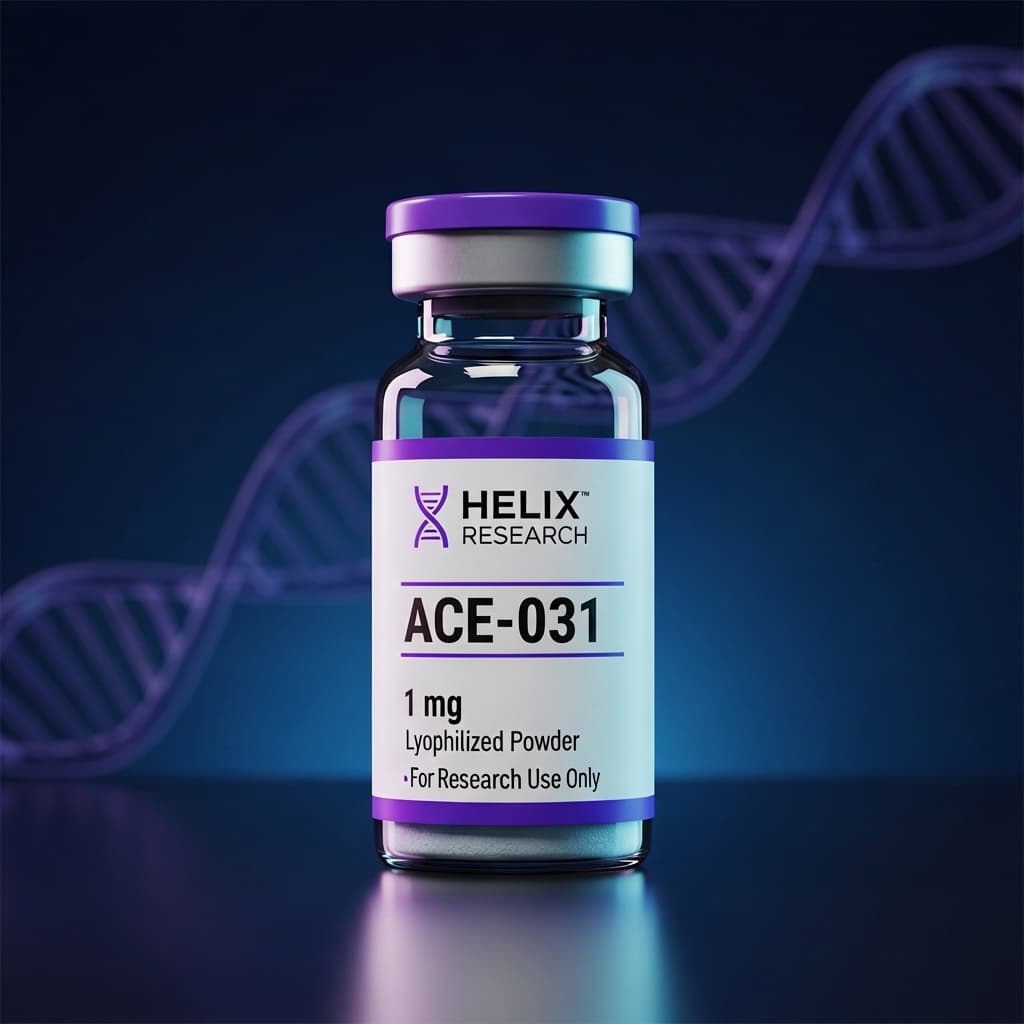
ACE 031
CAS: 1169766-01-1
Estudiado para la inhibición de la vía de miostatina en investigación muscular
ACE 031 is a research peptide in the specialty / research category. ACE-031 is a soluble decoy receptor consisting of the extracellular domain of activin receptor type IIB (ActRIIB) fused to a human IgG1 Fc domain. MiPeptidos offers ACE 031 in 1 sizes with 99.5% verified purity and full analytical documentation.
- Increased lean muscle mass
- Greater strength gains
- Improved bone density
- Better body composition
During weeks 1-4, research suggests the myostatin trap begins clearing growth-limiting signals, and studies report enhanced muscle pump and workout recovery. By weeks 5-8, clinical trials showed measurable lean body mass increases as the muscle growth brake is fully released. Weeks 9-12 typically bring the most visible muscle development, with strength gains compounding throughout the protocol.
$13.95/vial · Everything you need to start
Sin spam. Cancela en cualquier momento.
Análisis de Pureza HPLC
Unleash Muscle Growth.
12-week myostatin-blocking protocol using the ActRIIB decoy receptor studied in Duchenne muscular dystrophy clinical trials
ACE-031 is a soluble decoy receptor consisting of the extracellular domain of human activin receptor type IIB (ActRIIB) fused to a human IgG1 Fc domain. It functions as a 'ligand trap' — binding and neutralizing myostatin, activin A, GDF-11, and other TGF-β superfamily ligands that normally act as negative regulators of muscle growth. By sequestering these inhibitory signals, ACE-031 removes the molecular brakes on muscle hypertrophy.
Resultados Publicados
Revisado por ParesResultados cuantificables de investigación clínica publicada.
Lo que Dicen los Expertos
4 MédicosProfesionales e investigadores líderes que han estudiado y prescrito este péptido.
Dr. Se-Jin Lee
Professor of Genetics, University of Connecticut; Jackson Laboratory
PhD, Johns Hopkins. The scientist who discovered myostatin (GDF-8) in 1997. His knockout mice demonstrated that removing myostatin doubles muscle mass. One of the most important discoveries in muscle biology.
The myostatin knockout mice had roughly twice the amount of skeletal muscle as normal mice. Myostatin is a potent negative regulator of muscle growth, and its inhibition has enormous therapeutic potential for muscle-wasting conditions.
Myostatin inhibition produces consistent, dose-dependent muscle hypertrophy across species. Both genetic and pharmacological approaches (including ACE-031) confirm myostatin as a validated target for increasing muscle mass.
Fuente: McPherron et al. (1997) Nature; Lee & McPherron (2001) PNAS
Dr. Kathryn Wagner
Director, Center for Genetic Muscle Disorders, Kennedy Krieger Institute
MD, PhD. Professor of Neurology and Neuroscience, Johns Hopkins. Principal investigator on ACE-031 Phase II clinical trial in DMD. Leading authority on myostatin inhibition in neuromuscular disease.
ACE-031 demonstrated meaningful increases in lean body mass and total body mass in boys with Duchenne muscular dystrophy. The biological activity was clear — the challenge was the vascular side effects from the broad ligand trapping.
ACE-031 at 1-3 mg/kg every 2 weeks produced significant muscle mass increases in DMD patients. The compound demonstrated proof-of-concept but required more selective targeting to avoid BMP9/10 inhibition.
Fuente: Campbell et al. (2017) Muscle & Nerve; Kennedy Krieger clinical trial program
Dr. Andrew Huberman
Professor of Neurobiology, Stanford University
Ph.D. in Neuroscience. Host of Huberman Lab podcast. Extensively discusses myostatin biology, muscle growth regulation, and the TGF-β superfamily in the context of performance optimization.
Myostatin is essentially the brake pedal on muscle growth. When you remove that brake — whether through genetics, exercise-induced suppression, or pharmacological inhibition — muscle mass increases significantly.
Notes that resistance training naturally suppresses myostatin and that follistatin (a natural myostatin inhibitor) increases with exercise. Discusses pharmacological myostatin inhibition as an emerging therapeutic approach.
Fuente: Huberman Lab Podcast: Science of Muscle Growth (2022); muscle biology episodes
Dr. H. Lee Sweeney
Director, Myology Institute, University of Florida
PhD. Pioneer in gene therapy for muscular dystrophy. Expert in muscle biology and TGF-β superfamily signaling. Published landmark research on myostatin inhibition approaches for muscle disease.
The ActRIIB pathway is the most potent negative regulator of muscle mass we know of. ACE-031 proved that blocking this pathway in humans produces real, measurable muscle growth — the biology works exactly as predicted.
ActRIIB-Fc (ACE-031) is effective but too broad — it traps BMP9/BMP10 in addition to myostatin, causing vascular issues. More selective myostatin inhibitors are needed, but ACE-031 validated the target.
Fuente: Sweeney research publications; UF Myology Institute research program
Protocolo de Dosificación
3 FasesRégimen de dosificación paso a paso compilado de profesionales líderes e investigación clínica.
Conservative starting dose based on the low end of clinical trial range. ACE-031 has a ~10-15 day half-life due to Fc fusion, supporting biweekly dosing. Monitor for epistaxis and skin changes.
Clinical trial doses ranged from 0.5 to 3 mg/kg. Lean body mass increases were dose-dependent. Higher doses (3 mg/kg) showed more vascular side effects. Most research protocols target 1-2 mg/kg.
Allow 4-week washout (2-3 half-lives) to clear compound and assess retained muscle gains. Resistance training should continue during washout to maintain gains. DEXA scan recommended for objective lean mass assessment.
Reconstitute 1mg vial with 0.5 mL bacteriostatic water = 2 mg/mL. ACE-031 is a large fusion protein (~57 kDa) — dissolve gently by rolling, do not shake vigorously. Allow full dissolution before drawing.
12 weeks on, 4+ weeks off. ACE-031 has a long half-life (~10-15 days) due to Fc domain. Effects accumulate over multiple doses. Washout allows assessment of retained gains and monitoring for delayed side effects.
Lyophilized: store at -20°C. Reconstituted: 2-8°C, use within 14 days. ACE-031 is a protein — sensitive to heat, agitation, and repeated freeze-thaw. Handle gently.
Subcutaneous injection only. Large molecule — use 27-29 gauge needle. Inject slowly. Rotate sites. Due to Fc fusion, ACE-031 has extended circulation — biweekly dosing is sufficient. Do not inject intravenously.
Cronología de Recuperación
Basado en observaciones de investigación publicada. Los resultados individuales varían. Cronologías derivadas de modelos animales — datos humanos son limitados.
Myostatin Sequestration & Anabolic Signaling Onset
- ACE-031 binds and neutralizes circulating myostatin, activin A, and GDF-11
- Smad2/3 signaling (growth inhibition) suppressed in muscle satellite cells
- Myogenic regulatory factors (MyoD, myogenin) upregulated
- Early satellite cell activation and proliferation in skeletal muscle
- Measurable increases in lean body mass detectable by DEXA within 2-4 weeks
Base de investigación: Campbell et al. (2017) Muscle & Nerve; Attie et al. (2013) Muscle & Nerve
Active Muscle Hypertrophy
- Progressive lean body mass increases — dose-dependent effect confirmed in clinical trials
- Muscle fiber hypertrophy (increased cross-sectional area of existing fibers)
- Potential hyperplasia (new fiber formation) based on animal myostatin-knockout data
- Bone mineral density improvements as a secondary effect of TGF-β ligand trapping
- Strength gains begin to parallel the lean mass increases
Base de investigación: Campbell et al. (2017) Muscle & Nerve; Lee & McPherron (2001) PNAS
Peak Effect & Continued Accumulation
- Cumulative lean body mass gains reach maximum during ongoing treatment
- Muscle quality improvements — increased strength-to-mass ratio
- Continued bone mineral density improvements
- Monitor for vascular side effects (epistaxis, telangiectasia) — report if occurring
- Plan for washout and retention assessment
Base de investigación: Campbell et al. (2017) Muscle & Nerve; Acceleron Phase II data
Washout, Retention Assessment & Maintenance
- ACE-031 clears over 2-3 half-lives (~30-45 days)
- Myostatin signaling gradually resumes — satellite cell activation returns to baseline
- Resistance training is critical during this phase to retain gains
- DEXA scan recommended to quantify retained lean mass
- Vascular side effects (if present) should resolve within weeks of discontinuation
Base de investigación: Pharmacokinetic data from clinical trials; muscle biology post-anabolic stimulus
Mecanismo de Acción
4 vías biológicas distintas a través de las cuales opera este péptido.
ActRIIB Ligand Trap (Myostatin Sequestration)
ACE-031 acts as a soluble decoy receptor that binds and sequesters myostatin, activin A, GDF-11, and other TGF-β superfamily ligands before they can activate cell-surface ActRIIB, removing growth-inhibitory signals.
- Binds myostatin (GDF-8) with high affinity — the primary muscle growth inhibitor
- Also traps activin A and GDF-11, which contribute additional growth inhibition
- More effective than targeting myostatin alone — traps multiple inhibitory ligands simultaneously
Lee et al. (2005) PMID: 16275915; Attie et al. (2013) PMID: 23553751
Smad2/3 Suppression → Myogenic Gene Activation
By preventing ligand binding to ActRIIB, ACE-031 suppresses Smad2/3 phosphorylation — the intracellular signal that normally represses myogenic genes (MyoD, myogenin, Myf5) and satellite cell differentiation.
- Smad2/3 normally acts as a transcriptional repressor of muscle-specific genes
- Reduced Smad2/3 signaling permits MyoD and myogenin expression
- Satellite cells are released from quiescence and activated for proliferation/differentiation
McPherron et al. (1997) PMID: 9139826; Sartori et al. (2013) Molecular Cell
Satellite Cell Activation & Muscle Fiber Hypertrophy
Myostatin inhibition activates satellite cells (muscle stem cells), promoting their proliferation and fusion with existing muscle fibers — driving both hypertrophy (larger fibers) and potential hyperplasia (new fibers).
- Myostatin normally keeps satellite cells in quiescent G0 state
- ACE-031 releases satellite cells from quiescence → proliferation → differentiation
- Myostatin knockout mice show both hypertrophy and hyperplasia — more fibers, each larger
McPherron et al. (1997) PMID: 9139826; Wagner group clinical research
Bone Mineral Density Enhancement
ACE-031 traps activin A, which is a negative regulator of bone formation. Removing activin A signaling promotes osteoblast activity and increases bone mineral density — a beneficial secondary effect.
- Activin A inhibits osteoblast differentiation — trapping it promotes bone formation
- Bone formation markers (P1NP, bone-specific alkaline phosphatase) increased in clinical trials
- Dual benefit: stronger muscles supported by stronger bones
Attie et al. (2013) PMID: 23553751; Campbell et al. (2017) PMID: 27462804
Investigación Publicada
6 estudios revisados por pares de PubMed. Haz clic en cualquier PMID para ver el estudio completo.
Regulation of skeletal muscle mass in mice by a new TGF-beta superfamily member
McPherron AC, Lawler AM, Lee SJ — Nature (1997)
Hallazgo Clave: Discovery of myostatin (GDF-8). Myostatin knockout mice developed approximately double the skeletal muscle mass of wild-type mice — establishing myostatin as the primary negative regulator of muscle growth.
A Randomized Phase 2 Study of ACE-031 in Boys with Duchenne Muscular Dystrophy
Campbell C, McMillan HJ, Mah JK, Tarnopolsky M, Selby K, McClure T, et al. — Muscle & Nerve (2017)
Hallazgo Clave: ACE-031 produced significant increases in lean body mass and total body mass in DMD boys. Dose-dependent effect confirmed. Trial halted due to epistaxis and telangiectasias from BMP9/10 inhibition — not from myostatin inhibition itself.
A single ascending-dose study of muscle regulator ACE-031 in healthy volunteers
Attie KM, Borgstein NG, Yang Y, Condon CH, Wilson DM, Pearsall AE, et al. — Muscle & Nerve (2013)
Hallazgo Clave: Single doses of ACE-031 (0.02-3 mg/kg) in healthy postmenopausal women produced dose-dependent increases in lean body mass (up to 3.3% increase) and thigh muscle volume (up to 5.1% increase) within 29 days. Also increased bone formation markers.
Regulation of muscle growth by multiple ligands signaling through activin type II receptors
Lee SJ, Reed LA, Davies MV, Girgenrath S, Goad ME, Tomkinson KN, et al. — Proceedings of the National Academy of Sciences (2005)
Hallazgo Clave: ActRIIB-Fc (the ACE-031 mechanism) produced greater muscle mass increases than myostatin knockout alone — because it traps multiple TGF-β ligands (myostatin, activin A, GDF-11) that all suppress muscle growth.
A mutation in the myostatin gene increases muscle mass and enhances racing performance in heterozygote dogs
Mosher DS, Quignon P, Bustamante CD, Sutter NB, Mellersh CS, Parker HG, et al. — PLoS Genetics (2007)
Hallazgo Clave: Whippets heterozygous for a myostatin mutation ('Bully Whippets') were significantly faster racers. Homozygous mutations produced extreme muscling. First demonstration of myostatin's role in canine athletic performance.
Myostatin mutation associated with gross muscle hypertrophy in a child
Schuelke M, Wagner KR, Stolz LE, Hubner C, Riebel T, Komen W, et al. — New England Journal of Medicine (2004)
Hallazgo Clave: A child with a homozygous myostatin mutation exhibited extraordinary muscle development — visible muscle hypertrophy at birth. At 4.5 years, he could hold 3kg dumbbells with arms extended. First confirmed human myostatin loss-of-function case.
Potencia tu Protocolo de Investigación
4 SinergiasLa investigación sugiere combinar ACE 031 con estos péptidos para mecanismos complementarios.

Follistatin is a natural myostatin inhibitor. Combining it with ACE-031 provides dual-pathway myostatin suppression — endogenous (follistatin) and exogenous (ACE-031 decoy receptor).
Theoretical maximum myostatin suppression through two independent binding mechanisms. Most aggressive approach to removing muscle growth inhibition.

ACE-031 removes the brakes on muscle growth while IGF-1 LR3 pushes the accelerator — stimulating protein synthesis and satellite cell differentiation.
Remove inhibition (ACE-031) while adding stimulation (IGF-1 LR3). The theoretical maximum anabolic environment for muscle growth from peptide-based approaches.

BPC-157 supports tendon and connective tissue repair to keep up with rapid muscle growth induced by ACE-031, preventing injury from imbalanced tissue development.
Prevents the connective tissue injuries that commonly accompany rapid muscle growth. Ensures tendons and ligaments adapt alongside muscle development.

MK-677 increases GH and IGF-1 levels, providing anabolic support that complements ACE-031's myostatin inhibition for comprehensive muscle growth.
Multi-pathway muscle growth: myostatin inhibition (ACE-031) plus GH/IGF-1 axis stimulation (MK-677). Enhanced recovery, protein synthesis, and muscle development.
Especificaciones
Cómo Funciona ACE 031
ACE-031 is a soluble decoy receptor consisting of the extracellular domain of activin receptor type IIB (ActRIIB) fused to a human IgG1 Fc domain. It functions as a ligand trap, binding and neutralizing myostatin (GDF-8), activin A, GDF-11, and other TGF-beta superfamily ligands that negatively regulate muscle growth. By sequestering these ligands in the circulation, ACE-031 removes the natural brake on muscle growth, resulting in significant increases in muscle mass and strength. The Fc domain provides extended half-life through FcRn recycling.
Aplicaciones de Investigación
Precios
| Tamaño | Por Vial | Paquete de 10 |
|---|---|---|
1mg | $498.95 | $424.95 |
Precios de paquete de 10 mostrados. Descuentos por volumen para 50+ viales — contáctenos.
Certificado de Análisis
Este COA es una muestra representativa. Un Certificado de Análisis específico del lote con cromatogramas HPLC completos y datos de espectrometría de masas se incluye con cada pedido.
Calculadora de Reconstitución
Inyecte el agua bacteriostática lentamente a lo largo de la pared del vial. Agite suavemente hasta disolver — nunca sacuda. Almacene la solución reconstituida a 2-8°C y use dentro de 30 días.
Reseñas de Clientes
Preguntas Frecuentes
Seguridad y Advertencias
Clinical trial halted due to vascular side effects
The Phase II DMD trial of ACE-031 was halted after epistaxis (nosebleeds) and telangiectasias (dilated blood vessels) were observed. These are attributed to BMP9/BMP10 inhibition — ACE-031 traps these vascular regulators in addition to myostatin.
Not FDA-approved — investigational compound only
ACE-031 never received FDA approval. Development was discontinued by Acceleron Pharma. It is available only as a research compound. All information is for research and educational purposes.
Broad ligand trapping — off-target effects
ACE-031 traps not only myostatin but also activin A, GDF-11, BMP9, BMP10, and other TGF-β ligands. This produces beneficial effects (bone density) but also harmful ones (vascular integrity disruption). More selective agents are in development.
Solo para Fines de Investigación y Educación. No es consejo médico. No para consumo humano. Consulte a un médico autorizado antes de tomar cualquier decisión relacionada con la salud.
Péptidos Relacionados

AICAR
Compuesto mimético del ejercicio estudiado para la activación metabólica
ARA290 (Cibinetide)
Estudiado para neuroprotección mediante señalización no hematopoyética derivada de EPO
ACTH 1-39
Estudiado para la modulación de respuesta al estrés mediada por melanocortina

Cardiogen
Estudiado para la protección del tejido cardiovascular relacionada con la edad