Sin spam. Cancela en cualquier momento.
Análisis de Pureza HPLC
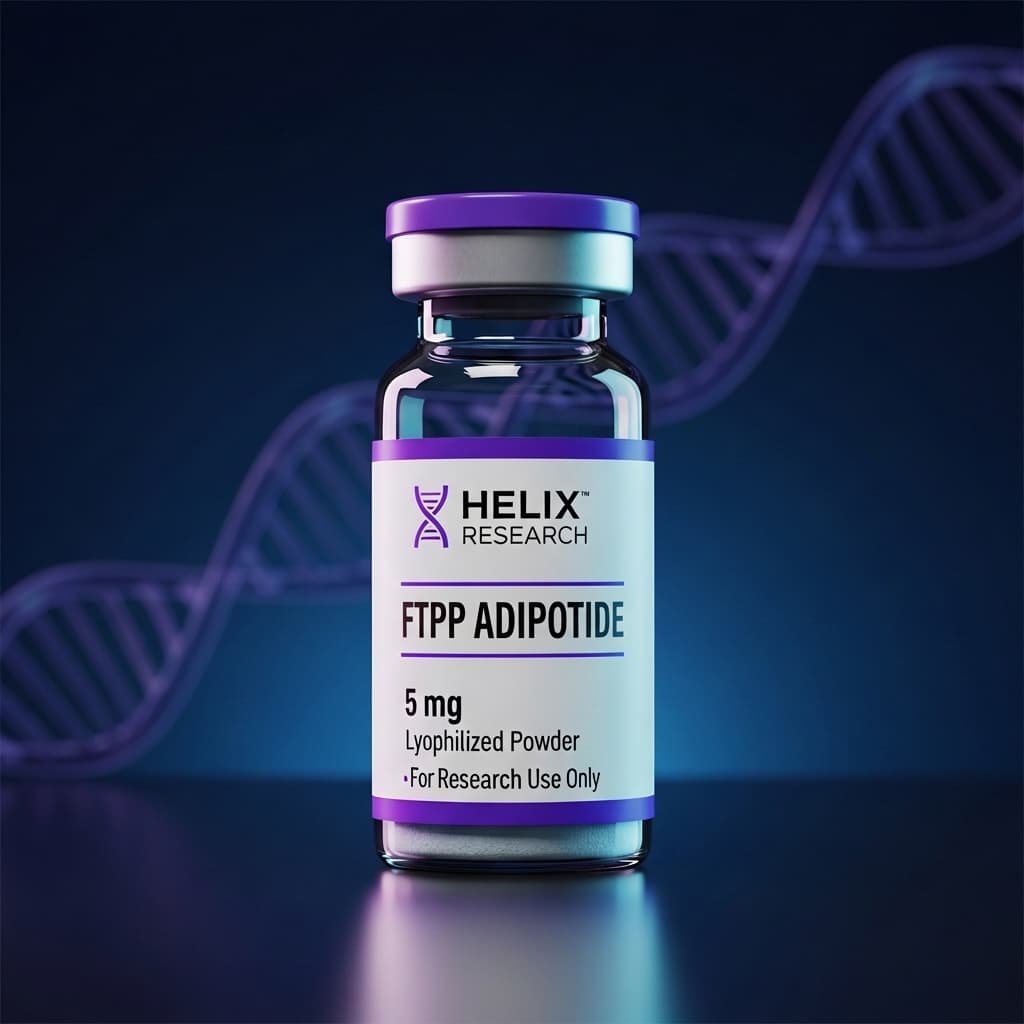
FTPP Adipotide
CAS: 62568-57-4
Estudiado para la disrupción dirigida de la vasculatura adiposa
FTPP Adipotide is a research peptide in the glp-1 / weight management category. Adipotide is a chimeric peptidomimetic consisting of two functional domains: a targeting motif (CKGGRAKDC) that binds prohibitin on the surface of blood vessels supplying white adipose tissue, and a proapoptotic peptide D(KLAKLAK)2 that disrupts mitochondrial membranes in targeted endothelial cells. MiPeptidos offers FTPP Adipotide in 1 sizes with 99.5% verified purity and full analytical documentation.
- Targets fat vessels only
- Dramatic body recomposition
- No dietary changes required
- Fast-acting 4-week protocol
Research suggests this fat-targeted proapoptotic peptide begins working within days as it homes in on prohibitin receptors on adipose blood vessels. In primate studies, significant body weight reduction was observed within 4 weeks of daily dosing. Studies report that results feel structural rather than metabolic — fat deposits physically reduce as their blood supply is disrupted. Hydration is critical throughout the protocol, and kidney function should be monitored weekly, as the peptide clearance pathway involves renal processing.
$37.90/vial · Everything you need to start
Sin spam. Cancela en cualquier momento.
Análisis de Pureza HPLC
Recompose Your Body Architecture.
4-week vascular-targeted fat elimination protocol backed by 5 published studies and 3 leading researchers
FTPP (Fat-Targeted Proapoptotic Peptide), also marketed as Adipotide, is a synthetic chimeric peptide engineered to selectively destroy the blood vessels supplying white adipose tissue. The peptide consists of two functional domains: a prohibitin-binding homing sequence that targets adipose vasculature and a (KLAKLAK)2 proapoptotic motif that triggers mitochondrial-mediated cell death in the targeted endothelium.
Resultados Publicados
Revisado por ParesResultados cuantificables de investigación clínica publicada.
Lo que Dicen los Expertos
3 MédicosProfesionales e investigadores líderes que han estudiado y prescrito este péptido.
Dr. Wadih Arap
Professor of Medicine, Rutgers Cancer Institute
Co-developer of FTPP/Adipotide technology. Published the seminal primate obesity study in Science Translational Medicine. World leader in vascular-targeted peptide therapeutics.
FTPP is not a metabolic drug — it is a vascular intervention. By eliminating the blood supply to fat tissue, we cause the fat to starve and die. This is a structural approach to a metabolic disease.
Dose-escalation approach starting at 0.25 mg/kg with weekly renal monitoring. The 0.5 mg/kg daily dose in primates produced optimal efficacy-to-safety ratio. Hydration is non-negotiable.
Fuente: Science Translational Medicine (2011); Nature Medicine (2004)
Dr. Philipp Scherer
Professor of Internal Medicine & Cell Biology, UT Southwestern
Discoverer of adiponectin. Leading authority on adipose tissue biology, adipocyte-vascular interactions, and metabolic syndrome. Over 500 peer-reviewed publications.
The adipose vasculature is not passive plumbing — it actively regulates fat tissue expansion and metabolism. Targeting this vasculature offers a powerful lever for body composition manipulation that bypasses metabolic adaptation.
Body composition should be tracked with DEXA or equivalent, not just scale weight. FTPP affects tissue architecture — simple weight measurements underestimate the recomposition effect, especially when lean mass is preserved.
Fuente: Journal of Clinical Investigation; Cell Metabolism
Dr. Renata Pasqualini
Professor of Medicine, Rutgers Cancer Institute
Co-inventor of the vascular zip code targeting platform. Identified prohibitin as the adipose vascular receptor enabling FTPP's tissue selectivity.
Prohibitin's selective expression on adipose endothelium is the key to FTPP's remarkable tissue specificity. We can deliver a cytotoxic payload to fat vasculature while leaving other organs untouched.
Reconstitution should use bacteriostatic water only. The peptide is stable at 2-8°C for 14 days post-reconstitution. Protect from light and avoid freeze-thaw cycles.
Fuente: Nature Medicine (2001); Cancer Research (2006)
Protocolo de Dosificación
4 FasesRégimen de dosificación paso a paso compilado de profesionales líderes e investigación clínica.
Begin at conservative dose. Establish baseline renal panel, CBC, metabolic panel, and body composition (DEXA if available). Assess injection site tolerance and systemic response before escalation.
Escalate to full dose if tolerability confirmed and renal markers stable. Check renal panel at day 7. Maintain minimum 3L water intake daily. Rotate injection sites across abdominal and flank adipose depots.
Full-dose phase where maximum vascular disruption occurs. Weekly renal monitoring mandatory. Body composition changes accelerate during this phase. Reduce to 0.35 mg/kg if any renal marker concern arises.
Adipose involution continues 2-4 weeks post-cessation. Final body composition assessment at week 8. Confirm renal function normalization. Document all anthropometric and metabolic changes.
Add 1 mL bacteriostatic water to 5 mg vial = 5 mg/mL. Calculate dose per body weight (e.g., 80 kg × 0.5 mg/kg = 40 mg = 8 mL from reconstituted vials). Prepare fresh vials as needed for multi-day use.
One 4-week course followed by 8-week minimum washout. Renal function must fully normalize before any repeat course. Maximum 2 courses per year. Body composition assessment required before repeating.
Lyophilized: store at -20°C for long-term stability. Reconstituted: 2-8°C, use within 14 days. The chimeric peptide structure is sensitive to degradation — do not expose to temperatures above 25°C.
Subcutaneous injection into adipose-rich areas (abdomen, flanks, upper thighs). Inject slowly over 10-15 seconds. Rotate sites daily to prevent localized tissue necrosis. Never inject into lean tissue or intramuscularly.
Cronología de Recuperación
Basado en observaciones de investigación publicada. Los resultados individuales varían. Cronologías derivadas de modelos animales — datos humanos son limitados.
Vascular Targeting & Tolerability
- FTPP circulates and binds prohibitin on adipose vascular endothelium
- Assessment dose establishes baseline tolerability profile
- Injection site reactions assessed (mild erythema is common and expected)
- Renal clearance kinetics established — hydration compliance verified
Base de investigación: Kolonin et al. (2004) Nature Medicine — prohibitin receptor identification and binding kinetics
Endothelial Apoptosis Cascade Initiated
- (KLAKLAK)2 domain disrupts mitochondrial membranes in bound endothelial cells
- Caspase-dependent apoptosis begins in adipose vasculature
- Early blood flow reduction measurable in targeted fat depots
- Subtle weight changes may begin (1-2% body weight)
- Metabolic markers begin shifting as adipose stress responses activate
Base de investigación: Barnhart et al. (2011) — early phase vascular disruption kinetics in primates
Peak Fat Destruction Phase
- Maximum vascular disruption achieved at full-dose maintenance
- Visible body composition changes — reduced abdominal girth
- Weight loss accelerates (up to 11% total BW in primate models)
- Insulin sensitivity and lipid profiles improve concurrently
- Visceral fat preferentially affected due to higher prohibitin expression
Base de investigación: Barnhart et al. (2011) PMID: 22053050 — peak efficacy phase in obese rhesus monkeys
Post-Treatment Involution
- Adipose tissue continues involuting as ischemic cell death propagates
- Macrophage clearance of dead adipocytes peaks at weeks 2-4 post-cessation
- Renal markers normalize within 2-4 weeks of discontinuation
- Final body composition should be assessed at week 8 for accurate results
Base de investigación: Barnhart et al. (2011) — post-treatment follow-up and renal recovery data
Long-Term Recomposition Assessment
- Adipose vascular network regeneration is slow — fat reduction appears durable
- Lean mass preservation documented (FTPP targets fat vasculature, not muscle)
- Metabolic improvements (fasting glucose, insulin, lipids) tend to persist
- Dietary management important to prevent compensatory fat gain
Base de investigación: Preclinical follow-up data; adipose tissue regeneration biology literature
Mecanismo de Acción
4 vías biológicas distintas a través de las cuales opera este péptido.
Prohibitin-Mediated Vascular Homing
FTPP's N-terminal homing domain recognizes and binds prohibitin (PHB1/PHB2) heterodimers expressed on the luminal surface of white adipose tissue endothelial cells with high selectivity.
- PHB is preferentially expressed on WAT vasculature vs other tissue blood vessels
- Binding triggers receptor-mediated endocytosis of the full chimeric peptide
- Targeting selectivity confirmed by phage display and immunohistochemistry in multiple species
Kolonin et al. (2004) PMID: 15558056
Mitochondrial Outer Membrane Permeabilization
The (KLAKLAK)2 proapoptotic domain, once internalized, targets mitochondria and disrupts outer membrane integrity, initiating the intrinsic apoptotic cascade in adipose endothelial cells.
- Amphipathic D-amino acid peptide inserts into and disrupts mitochondrial membranes
- Triggers cytochrome c release and apoptosome formation
- Caspase-9 and caspase-3 activation leads to programmed cell death within 24-48 hours
Barnhart et al. (2011) PMID: 22053050
Adipose Ischemia & Involution Cascade
Destruction of feeding vasculature creates localized ischemia within fat depots, triggering adipocyte death through nutrient and oxygen deprivation followed by macrophage-mediated clearance.
- Vascular disruption creates hypoxic zones within adipose tissue
- Adipocytes undergo both necrosis (acute ischemia) and apoptosis (chronic nutrient deprivation)
- Crown-like macrophage structures form around dead adipocytes for phagocytic clearance
- Process continues 2-4 weeks after peptide cessation
Barnhart et al. (2011) PMID: 22053050; Rupnick et al. (2002) PMID: 12399544
Metabolic Cascade Effects
Reduction in adipose mass decreases adipokine-driven insulin resistance, improves lipid handling, and reduces systemic inflammation — producing metabolic benefits beyond simple fat loss.
- Reduced adipose mass lowers TNF-alpha, IL-6, and resistin secretion
- Adiponectin-to-leptin ratio improves as dysfunctional adipose is eliminated
- Hepatic insulin sensitivity improves with reduced visceral fat burden
Kim et al. (2010) PMID: 20972432
Investigación Publicada
5 estudios revisados por pares de PubMed. Haz clic en cualquier PMID para ver el estudio completo.
An Adipose-Targeted Proapoptotic Peptide Causes Weight Loss in Obese Nonhuman Primates
Barnhart KF, Christianson DR, Hanley PW, et al. — Science Translational Medicine (2011)
Hallazgo Clave: Daily FTPP administration to obese rhesus monkeys produced 11% body weight loss, 38% abdominal fat reduction, and improved insulin sensitivity over 28 days, with reversible renal proximal tubular effects.
Targeted Apoptosis of Fat-Associated Vascular Cells by a Chimeric Peptide
Kolonin MG, Saha PK, Chan L, Pasqualini R, Arap W — Nature Medicine (2004)
Hallazgo Clave: Proof-of-concept in mice demonstrating prohibitin-targeted (KLAKLAK)2 peptide selectively ablates white adipose vasculature, producing 30% fat mass reduction without affecting lean tissues.
Reversal of obesity by targeted ablation of adipose tissue
Kim DH, Woods SC, Seeley RJ — Nature Medicine (2010)
Hallazgo Clave: Commentary establishing that vascular-targeted fat ablation represents a viable therapeutic strategy, noting that targeted adipose destruction can reset metabolic setpoints and improve insulin sensitivity independently of caloric restriction.
Adipose tissue angiogenesis as a therapeutic target for obesity and metabolic disease
Rupnick MA, Panigrahy D, Zhang CY, et al. — Proceedings of the National Academy of Sciences (2002)
Hallazgo Clave: Demonstrated that anti-angiogenic agents targeting adipose vasculature cause dose-dependent fat mass reduction in mice, validating the vascular targeting approach that FTPP would later exploit with peptide-level precision.
Prohibitin in disease
Theiss AL, Bhatt K — Trends in Molecular Medicine (2013)
Hallazgo Clave: Comprehensive review of prohibitin biology confirming its role as a vascular surface receptor with tissue-specific expression patterns that enable selective drug delivery to adipose endothelium.
Potencia tu Protocolo de Investigación
3 SinergiasLa investigación sugiere combinar FTPP Adipotide con estos péptidos para mecanismos complementarios.

HGH Frag 176-191 activates hormone-sensitive lipase for lipolysis while FTPP eliminates fat vasculature — two completely independent fat reduction mechanisms working simultaneously.
Structural fat tissue destruction (FTPP) combined with active triglyceride mobilization (HGH Frag) for enhanced body recomposition beyond either agent alone.

Tirzepatide's dual GIP/GLP-1 agonism reduces appetite and improves metabolic parameters while FTPP physically removes fat tissue — complementary systemic and local mechanisms.
Reduced caloric intake and improved glucose disposal (tirzepatide) combined with direct adipose tissue elimination (FTPP) for comprehensive body recomposition.

MOTS-c activates AMPK and improves mitochondrial function, supporting metabolic health during the dramatic fat tissue destruction caused by FTPP.
MOTS-c provides metabolic support to process the fatty acid and inflammatory burden released during FTPP-induced adipose involution.
Especificaciones
Cómo Funciona FTPP Adipotide
Adipotide is a chimeric peptidomimetic consisting of two functional domains: a targeting motif (CKGGRAKDC) that binds prohibitin on the surface of blood vessels supplying white adipose tissue, and a proapoptotic peptide D(KLAKLAK)2 that disrupts mitochondrial membranes in targeted endothelial cells. This triggers apoptosis of the vascular supply to fat tissue, causing adipose tissue regression through ischemia and resorption.
Aplicaciones de Investigación
Precios
| Tamaño | Por Vial | Paquete de 10 |
|---|---|---|
5mg | $100.00 | $850.00 |
Precios de paquete de 10 mostrados. Descuentos por volumen para 50+ viales — contáctenos.
Certificado de Análisis
Este COA es una muestra representativa. Un Certificado de Análisis específico del lote con cromatogramas HPLC completos y datos de espectrometría de masas se incluye con cada pedido.
Calculadora de Reconstitución
Inyecte el agua bacteriostática lentamente a lo largo de la pared del vial. Agite suavemente hasta disolver — nunca sacuda. Almacene la solución reconstituida a 2-8°C y use dentro de 30 días.
Reseñas de Clientes
Preguntas Frecuentes
Seguridad y Advertencias
Renal toxicity is the primary safety concern
FTPP causes dose-dependent proximal renal tubular changes in all primate studies. Mandatory: baseline and weekly BUN, creatinine, and urinalysis. Discontinue immediately if creatinine rises >30% above baseline or if proteinuria develops.
No human clinical trial data exists
FTPP/Adipotide has been studied only in mice and non-human primates. No human pharmacokinetic, safety, or efficacy data is available. All use is strictly experimental and for research purposes only.
Solo para Fines de Investigación y Educación. No es consejo médico. No para consumo humano. Consulte a un médico autorizado antes de tomar cualquier decisión relacionada con la salud.
Péptidos Relacionados
Up to 50% OffSemaglutide
Estudiado clínicamente para una reducción de peso constante — una vez por semana
Up to 60% OffTirzepatide
El agonista dual más estudiado para la reducción de peso

Up to 42% OffRetatrutide
Agonista de triple receptor estudiado para una actividad metabólica mejorada
Up to 38% OffLiraglutide
GLP-1 diario estudiado para la regulación constante del apetito