Sin spam. Cancela en cualquier momento.
Análisis de Pureza HPLC
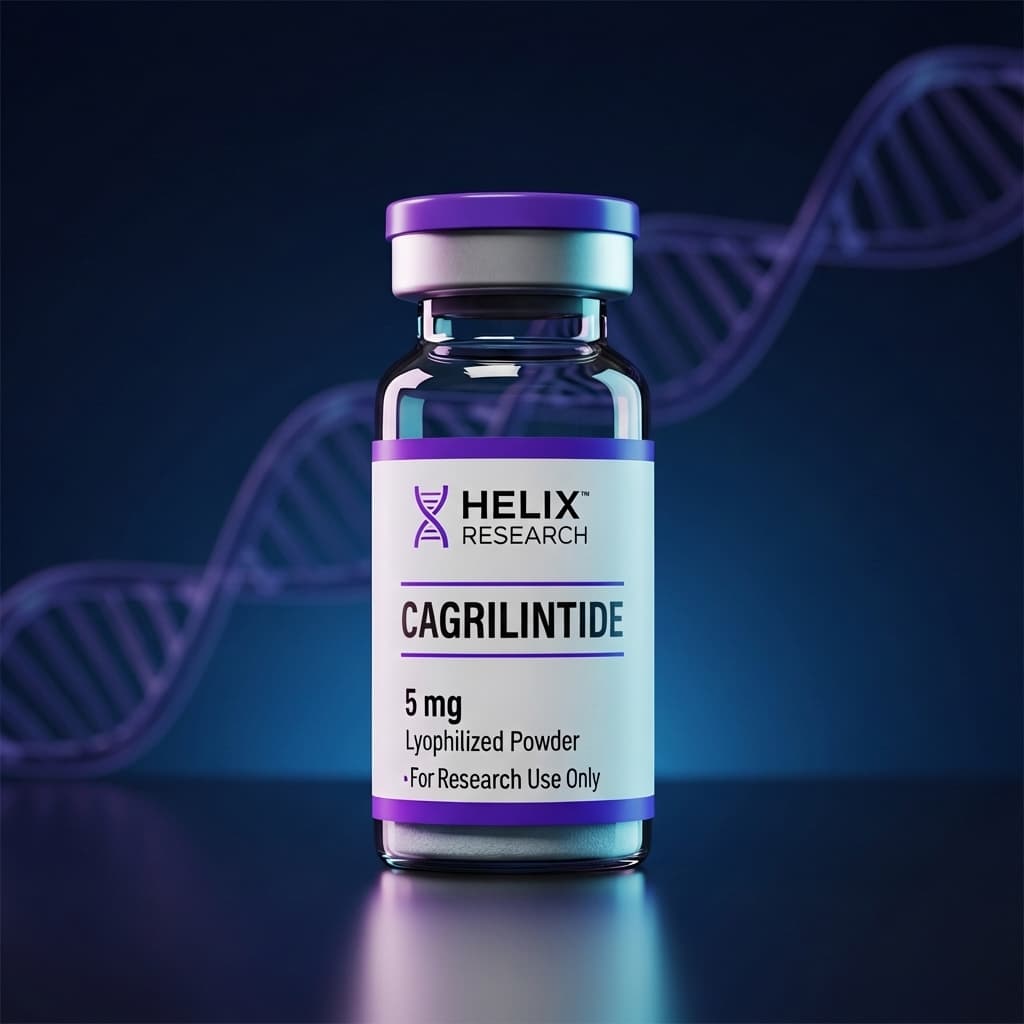
Cagrilintide
CAS: 1415456-99-3
Estudiado para vías de saciedad mediadas por amilina más allá del GLP-1
Cagrilintide is a research peptide in the glp-1 / weight management category. Cagrilintide is a long-acting amylin receptor agonist that mimics the satiety effects of the pancreatic hormone amylin. MiPeptidos offers Cagrilintide in 2 sizes with 99.8% verified purity and full analytical documentation.
- Reduced portion sizes
- Less post-meal hunger
- Once-weekly convenience
- Pairs well with GLP-1 peptides
Research indicates feeling full faster during meals within the first 1-2 weeks. Cagrilintide works through the amylin pathway — a satiety signal in the brainstem that is separate from GLP-1 — so the sensation is often described as meals simply feeling more satisfying. By weeks 8-12, studies report an average of about 10% body weight reduction as a standalone agent. Many researchers find it most effective when combined with a GLP-1 agonist like semaglutide for dual-pathway appetite control.
$37.90/vial · Everything you need to start
Sin spam. Cancela en cualquier momento.
Análisis de Pureza HPLC
Amylin-Powered Satiety.
16-week amylin analog protocol targeting the satiety pathway GLP-1 agonists miss
Cagrilintide is a long-acting amylin receptor agonist developed by Novo Nordisk. Amylin is a hormone co-secreted with insulin from pancreatic beta cells that plays a crucial role in satiety, gastric emptying, and post-meal glucagon suppression. Pramlintide (Symlin) was the first amylin analog, but its short half-life required dosing with every meal. Cagrilintide's acylation technology extends the half-life to enable once-weekly dosing.
Resultados Publicados
Revisado por ParesResultados cuantificables de investigación clínica publicada.
Lo que Dicen los Expertos
4 MédicosProfesionales e investigadores líderes que han estudiado y prescrito este péptido.
Dr. David Lau
Professor of Medicine, University of Calgary
Endocrinologist and obesity researcher. Lead investigator in cagrilintide Phase 2 trials. Expert in incretin and amylin-based therapies.
Cagrilintide demonstrates that amylin receptor agonism is a viable pathway for weight management. The once-weekly formulation solves the adherence challenges that limited pramlintide.
Dose escalation from 0.25mg to 2.4mg over 8-10 weeks. Monitor for nausea during escalation — amylin-mediated GI effects differ from GLP-1 nausea in character and timing.
Fuente: Cagrilintide Phase 2 obesity trial (Lancet, 2021, PMID: 34798060)
Dr. John Wilding
Professor of Medicine, University of Liverpool
Lead investigator of STEP 1 (semaglutide) and principal investigator in CagriSema development. One of the world's leading obesity medicine researchers.
The amylin pathway is complementary to GLP-1. Cagrilintide accesses satiety circuits in the area postrema that GLP-1 agonists don't fully engage, which is why the combination is so promising.
Cagrilintide's value is greatest in combination with GLP-1 agonists. As monotherapy, expect ~10% weight loss. Combined with semaglutide (CagriSema), expect 20%+ weight loss.
Fuente: CagriSema Phase 2 data presentations; Lancet commentaries
Dr. Tamer Coskun
Vice President, Research, Eli Lilly and Company
Pharmacologist who led preclinical development of multiple incretin and amylin-based therapeutics. Key contributor to understanding poly-hormone approaches to obesity.
Amylin receptor agonists represent an orthogonal approach to appetite control. The brainstem circuits activated by amylin are distinct from hypothalamic GLP-1 pathways.
The science supports combining amylin and GLP-1 pathways for maximum satiety. Single-agent amylin agonism is effective but optimally used as part of combination strategies.
Fuente: Nature Reviews Drug Discovery amylin reviews; Eli Lilly research publications
Dr. Steve Bloom
Professor of Medicine, Imperial College London
Pioneer in gut hormone research. Head of Division of Diabetes, Endocrinology and Metabolism at Imperial. Decades of research on appetite-regulating hormones including amylin.
Amylin is the forgotten satiety hormone. It acts on the area postrema — a brain region outside the blood-brain barrier — providing direct meal-termination signals that complement GLP-1.
Amylin analogs are particularly effective at reducing meal size and post-meal glucose excursions. Consider for patients who eat normal-frequency meals but consume excessive portions.
Fuente: Imperial College gut hormone research program; Diabetes Obesity and Metabolism reviews
Protocolo de Dosificación
3 FasesRégimen de dosificación paso a paso compilado de profesionales líderes e investigación clínica.
Low starting dose for amylin receptor adaptation. Nausea pattern differs from GLP-1 agents — tends to be more meal-related. Inject on the same day each week.
Escalate by one dose level every 2 weeks as tolerated. If nausea is significant at any level, hold for an additional 2 weeks before escalating. Target is 2.4mg.
Target maintenance dose from Phase 2 data. Cagrilintide 4.5mg was also studied but 2.4mg offered the best efficacy-to-tolerability ratio. Continue with dietary modifications.
Research-grade lyophilized cagrilintide: reconstitute 5mg vial with 1mL bacteriostatic water = 5mg/mL. For 0.25mg = 0.05mL (5 units). For 2.4mg = 0.48mL (48 units). Use insulin syringes for precise dosing.
Cagrilintide is designed for continuous long-term use based on clinical trial design. No cycling data exists. Weight regain is expected upon discontinuation, similar to GLP-1 agonists.
Lyophilized: store at -20°C. Reconstituted: refrigerate at 2-8°C, use within 30 days. Protect from light. The acylated peptide is stable but sensitive to temperature extremes.
Subcutaneous injection once weekly on the same day. Rotate injection sites. If combining with semaglutide (CagriSema approach), inject at separate sites. Timing of day does not matter.
Cronología de Recuperación
Basado en observaciones de investigación publicada. Los resultados individuales varían. Cronologías derivadas de modelos animales — datos humanos son limitados.
Amylin Receptor Activation & Adaptation
- Amylin receptor activation in area postrema begins — meal-termination signals enhanced
- Post-meal satiety noticeably increased — portions naturally reduce
- Gastric emptying slowed through amylin-specific vagal pathways
- Nausea tends to be meal-associated rather than constant (differs from GLP-1 pattern)
- Typical weight loss: 1-2% of body weight
Base de investigación: Lau et al. (2021) Lancet Phase 2 (PMID: 34798060)
Dose Escalation & Growing Satiety Effects
- Progressive dose increases to 2.4mg enhance amylin-mediated satiety
- Meal sizes decrease as area postrema signaling strengthens
- Post-meal glucagon suppression improves glucose control
- GI side effects stabilize as amylin receptor tolerance develops
- Typical weight loss: 4-7% of body weight
Base de investigación: Lau et al. (2021) Lancet Phase 2 dose-response data
Maintenance Dose & Active Weight Loss
- Full amylin receptor agonism at 2.4mg maintenance dose
- Consistent appetite reduction and meal-size moderation
- Metabolic parameters (glucose, triglycerides) improving
- Weight loss trajectory stabilizing at ~0.5-0.8 kg per week
- Typical weight loss: 8-10% of body weight
Base de investigación: Cagrilintide Phase 2 26-week data (PMID: 34798060)
Sustained Loss & Combination Assessment
- 10.8% mean weight loss at 26 weeks with cagrilintide 4.5mg in Phase 2
- 7.0% weight loss at 2.4mg dose — meaningful but less than GLP-1 agents alone
- Consider adding semaglutide (CagriSema approach) for patients seeking >15% loss
- Cardiovascular and metabolic benefits sustained with ongoing treatment
- Weight regain occurs upon discontinuation — ongoing therapy recommended
Base de investigación: Lau et al. (2021) Lancet (PMID: 34798060); CagriSema Phase 2 data
Mecanismo de Acción
3 vías biológicas distintas a través de las cuales opera este péptido.
Amylin Receptor Agonism (Area Postrema)
Activates amylin receptors (calcitonin receptor + RAMP complexes) in the area postrema — a circumventricular organ with direct blood access — to generate meal-termination signals.
- Area postrema lacks blood-brain barrier — directly accessible to circulating amylin analogs
- Activates calcitonin receptor/RAMP1 and RAMP3 complexes for satiety signaling
- Reduces meal size rather than meal frequency — a distinct mechanism from GLP-1
- Long-acting acylation provides sustained signaling between weekly injections
Lutz et al. (2018) J Endocrinology (PMID: 30307155)
Post-Meal Glucagon Suppression
Suppresses inappropriate postprandial glucagon secretion, reducing hepatic glucose output and post-meal glucose excursions.
- Amylin co-secretion with insulin normally suppresses glucagon after meals
- In T2D, amylin deficiency contributes to postprandial hyperglucagonemia
- Cagrilintide restores this physiological glucagon suppression
- Reduces post-meal glucose spikes independent of insulin secretion
Pramlintide clinical data; amylin physiology reviews
Gastric Emptying Regulation (Vagal Pathway)
Slows gastric emptying through vagal nerve pathways distinct from GLP-1-mediated gastric slowing, contributing to satiety and glucose control.
- Amylin-mediated gastric slowing acts through vagal afferents from area postrema
- Distinct mechanism from GLP-1 gastric emptying delay — potentially additive when combined
- Reduces rate of nutrient delivery to small intestine, blunting glucose spikes
- Primary driver of meal-associated nausea during dose escalation
Lutz et al. (2018) J Endocrinology; pramlintide GI studies
Investigación Publicada
4 estudios revisados por pares de PubMed. Haz clic en cualquier PMID para ver el estudio completo.
Once-weekly cagrilintide for weight management in people with overweight and obesity: a multicentre, randomised, double-blind, placebo-controlled and active-controlled, dose-finding phase 2 trial
Lau DCW, Erichsen L, Francisco-Ziller N, Hartvig H, et al. — The Lancet (2021)
Hallazgo Clave: Cagrilintide 4.5mg achieved 10.8% weight loss at 26 weeks vs 3.0% placebo. Dose-response confirmed across 0.3mg-4.5mg range. GI events were manageable with dose escalation.
CagriSema, a co-administered GLP-1 receptor agonist and amylin analog, showed 22.7% weight loss in a phase 2 trial
Enebo LB, Berthelsen KK, Kankam M, et al. — Nature Medicine (2021)
Hallazgo Clave: CagriSema (cagrilintide 2.4mg + semaglutide 2.4mg) achieved 17.1% weight loss at 20 weeks — significantly more than either agent alone. Validates the dual-pathway hypothesis.
Amylin as a future obesity treatment
Lutz TA, Coester B, Whiting L, et al. — Journal of Endocrinology (2018)
Hallazgo Clave: Comprehensive review of amylin biology: acts on area postrema to reduce meal size, suppresses glucagon, slows gastric emptying. Amylin analogs synergize with GLP-1 agonists through distinct CNS pathways.
Pramlintide as an Adjunct to Insulin Therapy: A Meta-analysis
Singh-Franco D, Perez A, Harrington C. — Clinical Therapeutics (2011)
Hallazgo Clave: Meta-analysis of pramlintide (first-gen amylin analog): reduced HbA1c by 0.3% and body weight by 1.6-2.6 kg. Established clinical proof-of-concept for amylin receptor agonism. Cagrilintide vastly improves upon pramlintide's pharmacokinetics.
Potencia tu Protocolo de Investigación
3 SinergiasLa investigación sugiere combinar Cagrilintide con estos péptidos para mecanismos complementarios.

The combination of cagrilintide + semaglutide (CagriSema) achieved 22.7% weight loss by combining amylin and GLP-1 satiety pathways — nearly double either agent alone.
This is the intended clinical combination. CagriSema is in Phase 3 trials and may become the most effective non-surgical weight loss treatment available.

Combining amylin (cagrilintide) with dual GIP/GLP-1 agonism (tirzepatide) would theoretically engage three distinct satiety pathways simultaneously.
Theoretical combination — not yet studied in clinical trials. Would represent the broadest receptor coverage of any weight management strategy. Monitor closely for GI tolerability.
Especificaciones
Cómo Funciona Cagrilintide
Cagrilintide is a long-acting amylin receptor agonist that mimics the satiety effects of the pancreatic hormone amylin. It activates amylin receptors (AMY1 and AMY3) and calcitonin receptors in the area postrema and nucleus tractus solitarius of the brainstem, reducing appetite and food intake. The C20 fatty acid modification enables albumin binding for extended duration of action. It is being developed in combination with semaglutide (CagriSema) for enhanced weight loss.
Aplicaciones de Investigación
Precios
| Tamaño | Por Vial | Paquete de 10 | Ahorro |
|---|---|---|---|
5mgOferta | $84.95$100.00 | $722.07 | 15% descuento |
10mgMejor Valor | $160.00 | $1360.00 | — |
Precios de paquete de 10 mostrados. Descuentos por volumen para 50+ viales — contáctenos.
Certificado de Análisis
Este COA es una muestra representativa. Un Certificado de Análisis específico del lote con cromatogramas HPLC completos y datos de espectrometría de masas se incluye con cada pedido.
Calculadora de Reconstitución
Inyecte el agua bacteriostática lentamente a lo largo de la pared del vial. Agite suavemente hasta disolver — nunca sacuda. Almacene la solución reconstituida a 2-8°C y use dentro de 30 días.
Reseñas de Clientes
Preguntas Frecuentes
Seguridad y Advertencias
Investigational compound — not approved for any use
Cagrilintide has no regulatory approval anywhere. It is in Phase 3 development as part of CagriSema. All use is purely investigational.
Potential thyroid and pancreatitis risks (class effects)
While cagrilintide is an amylin analog (not GLP-1), combination use with semaglutide carries GLP-1 class warnings including thyroid C-cell tumors and pancreatitis risk.
Solo para Fines de Investigación y Educación. No es consejo médico. No para consumo humano. Consulte a un médico autorizado antes de tomar cualquier decisión relacionada con la salud.
Péptidos Relacionados
Up to 50% OffSemaglutide
Estudiado clínicamente para una reducción de peso constante — una vez por semana
Up to 60% OffTirzepatide
El agonista dual más estudiado para la reducción de peso
Up to 42% OffRetatrutide
Agonista de triple receptor estudiado para una actividad metabólica mejorada
Up to 38% OffLiraglutide
GLP-1 diario estudiado para la regulación constante del apetito