Sin spam. Cancela en cualquier momento.
Análisis de Pureza HPLC
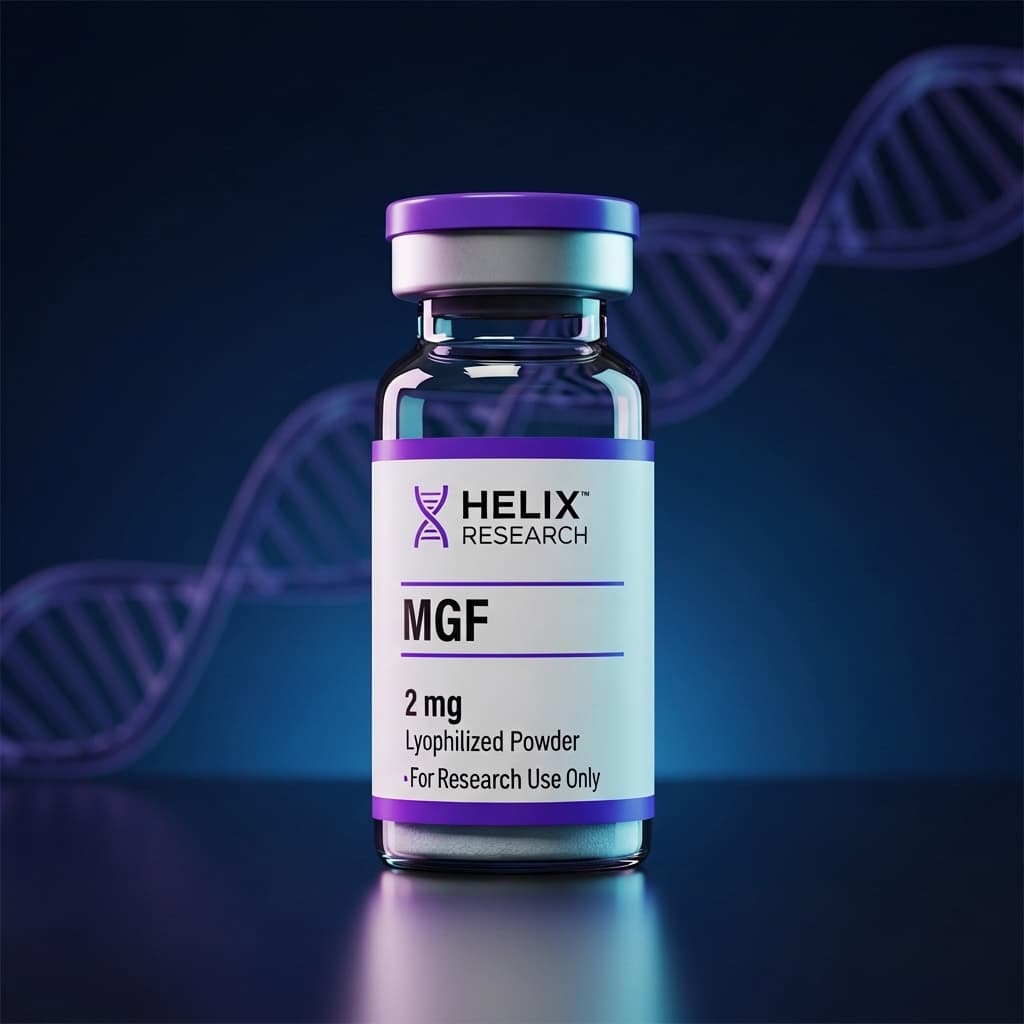
MGF
CAS: Not formally assigned for the synthetic fragment
Estudiado para la activación localizada de células satélite musculares
MGF is a research peptide in the growth hormone / gh secretagogues category. MGF is a splice variant of IGF-1 produced in mechanically stressed muscle tissue. MiPeptidos offers MGF in 1 sizes with 99.5% verified purity and full analytical documentation.
- Activates muscle stem cells
- Localized muscle repair
- Faster soreness recovery
- Targeted injury healing
Research suggests satellite (muscle stem) cells activate within hours of local administration. Studies report reduced soreness in injected muscle groups within the first week. Over a 3-4 week protocol, research suggests enhanced muscle repair and growth at targeted sites. Best used immediately post-workout for maximum effect.
$18.20/vial · Everything you need to start
Sin spam. Cancela en cualquier momento.
Análisis de Pureza HPLC
Activate Muscle Stem Cells.
4-week targeted protocol for satellite cell activation and localized muscle repair
Mechano Growth Factor (MGF) is a splice variant of Insulin-like Growth Factor-1 (IGF-1) produced specifically in mechanically stressed muscle tissue. When skeletal muscle is damaged by exercise or injury, the IGF-1 gene undergoes alternative splicing to produce MGF, which activates quiescent muscle satellite cells (adult stem cells) to initiate repair and hypertrophy.
Resultados Publicados
Revisado por ParesResultados cuantificables de investigación clínica publicada.
Lo que Dicen los Expertos
4 MédicosProfesionales e investigadores líderes que han estudiado y prescrito este péptido.
Dr. Geoffrey Goldspink
Professor Emeritus, University College London
Discoverer of Mechano Growth Factor. Pioneer of skeletal muscle molecular biology. Published the foundational work characterizing MGF's role in muscle repair and satellite cell activation.
MGF is the local muscle repair signal — it is produced by the muscle itself in response to mechanical damage and activates the satellite cells that are the muscle's regenerative reserve.
MGF acts locally. Research administration: 100–200 mcg injected near target muscle immediately post-exercise or post-injury. Rapid half-life means timing is critical.
Fuente: Goldspink (2005) J Physiol; Yang & Goldspink (2002) FEBS Letters
Dr. William Seeds
Founder, SSRP Institute
40+ years in cellular and molecular medicine. Author of 'Peptide Protocols: Volume 1'.
MGF is uniquely targeted — it activates satellite cells right at the injection site. The short half-life means you need to inject it locally and quickly. For systemic effects, use PEG-MGF instead.
200 mcg subcutaneous near target muscle, immediately post-training. Use bilaterally for symmetry. Short cycles (3–4 weeks). PEG-MGF for systemic applications.
Fuente: Peptide Protocols: Volume 1 (ISBN: 978-0578624358)
Dr. Andrew Huberman
Professor of Neurobiology, Stanford University
Ph.D. in Neuroscience. Host of Huberman Lab.
MGF is fascinating from a muscle biology perspective — it's the signal your body uses to wake up satellite cells after exercise. The challenge is its extremely short half-life, which limits practical application.
Consider MGF as a localized signal amplifier for specific muscle recovery. Post-exercise timing is critical due to the short half-life. PEG-MGF extends the window for systemic applications.
Fuente: Huberman Lab Podcast: Muscle Growth & Recovery Discussions
Dr. Stephen Harridge
Professor of Human & Applied Physiology, King's College London
Published extensively on muscle aging, satellite cell biology, and growth factor signaling in skeletal muscle. Collaborator with Goldspink on MGF research.
The mechano-growth factor variant of IGF-1 is specifically involved in the activation of muscle satellite cells. It represents a distinct local signal separate from the endocrine IGF-1 system.
Research application: local administration post-mechanical stress. MGF activates satellite cells to enter the cell cycle — the first step in muscle repair and hypertrophy.
Fuente: Hameed et al. (2003) J Physiol; Harridge (2003) Exp Physiol
Protocolo de Dosificación
2 FasesRégimen de dosificación paso a paso compilado de profesionales líderes e investigación clínica.
Inject within 30 minutes of training due to extremely short half-life. Bilateral injection for symmetry. Maximum 2–3 muscle groups per session. Rotate injection sites.
For targeted muscle injury recovery. Short duration due to localized action and cost. Combine with PEG-MGF for extended systemic support.
Add 1 mL bacteriostatic water to 2 mg vial = 2,000 mcg/mL. 200 mcg = 10 units on insulin syringe.
Short cycles only: 3–4 weeks on, 4 weeks off. MGF's localized action doesn't require extended protocols. Can be cycled frequently with adequate rest between cycles.
Lyophilized: -20°C. Reconstituted: 2–8°C, use within 14 days. MGF is fragile — reconstitute immediately before use when possible.
Subcutaneous injection. MUST be administered immediately post-exercise or post-injury for maximum satellite cell activation. Inject subcutaneously near the target muscle. Very short half-life means timing is everything.
Cronología de Recuperación
Basado en observaciones de investigación publicada. Los resultados individuales varían. Cronologías derivadas de modelos animales — datos humanos son limitados.
Satellite Cell Activation
- Satellite cells activated within hours of local administration
- Enhanced DOMS recovery in injected muscle groups
- Local inflammatory response modulated at injection sites
- No systemic effects due to rapid local degradation
- Satellite cells enter the cell cycle (G0 → G1 transition)
Base de investigación: Yang & Goldspink (2002) FEBS Letters; Hill et al. (2003)
Myoblast Proliferation & Early Repair
- Activated satellite cells proliferating as myoblasts
- Enhanced muscle fiber repair at injection sites
- Improved recovery between training sessions for targeted muscles
- Progressive strength recovery in injured muscles
- Possible localized swelling at injection sites (transient)
Base de investigación: Goldspink (2005) J Physiol; satellite cell biology literature
Myoblast Fusion & Fiber Remodeling
- Myoblasts fusing into existing muscle fibers (hypertrophy contribution)
- Enhanced muscle repair at previously damaged sites
- Improved muscle function and strength
- Protocol completion — transition to maintenance or off-cycle
Base de investigación: Goldspink (2005); muscle satellite cell fusion literature
Consolidation
- Muscle fibers continue remodeling from satellite cell contributions
- Strength and size gains solidify
- Consider PEG-MGF for systemic support during off-cycle
- Can restart MGF cycle for different muscle groups
Base de investigación: Muscle biology — satellite cell fusion and maturation timeline
Mecanismo de Acción
3 vías biológicas distintas a través de las cuales opera este péptido.
Satellite Cell Activation (G0 → G1)
MGF's E-peptide domain directly activates quiescent satellite cells, causing them to exit G0 dormancy and enter the cell cycle for proliferation and eventual muscle fiber repair.
- 25% increase in satellite cell proliferation within 72 hours
- Specifically targets the G0 → G1 transition (dormant → active)
- Action is local — limited by rapid enzymatic degradation
Yang & Goldspink (2002) PMID: 11943200
Mechano-Transduction Response
MGF is produced by alternative splicing of the IGF-1 gene in response to mechanical stress, serving as the initial local signal linking muscle damage to satellite cell-mediated repair.
- Expressed within 2.5 hours of resistance exercise in humans
- Expression correlates with mechanical loading magnitude
- Distinct from systemic IGF-1 — purely local autocrine/paracrine signal
Hameed et al. (2003) PMID: 12813142
Age-Related Decline
MGF expression declines significantly with aging, contributing to reduced satellite cell activation and the progressive muscle loss (sarcopenia) seen in elderly populations.
- Elderly show significantly reduced MGF expression after exercise
- Loss of MGF signal may explain age-related satellite cell quiescence
- Exogenous MGF may partially restore age-related satellite cell activation
Hameed et al. (2004) PMID: 15034141
Investigación Publicada
4 estudios revisados por pares de PubMed. Haz clic en cualquier PMID para ver el estudio completo.
Mechano growth factor: a local growth factor produced by muscle
Goldspink G — Journal of Physiology (2005)
Hallazgo Clave: MGF is produced by alternative splicing of the IGF-1 gene in response to mechanical stress. It specifically activates muscle satellite cells and is distinct from systemic IGF-1.
Expression of MGF E peptide in muscle progenitor cells increases proliferation
Yang SY, Goldspink G — FEBS Letters (2002)
Hallazgo Clave: The MGF E-peptide increased satellite cell proliferation by 25% within 72 hours. MGF-treated cells showed significantly higher rates of cell cycle entry (G0 → G1 transition).
Mechano growth factor expression in exercised human muscle
Hameed M, Orrell RW, Cobbold M, Goldspink G, Harridge SD — Journal of Physiology (2003)
Hallazgo Clave: Exercise-induced MGF expression was detectable in human muscle within 2.5 hours of resistance exercise. MGF expression correlated with the magnitude of mechanical loading.
Loss of MGF splice variant in aged human skeletal muscle
Hameed M, Lange KH, Andersen JL, et al. — Journal of Physiology (2004)
Hallazgo Clave: Elderly men showed significantly reduced MGF expression after resistance exercise compared to young men. Age-related loss of MGF may contribute to sarcopenia.
Potencia tu Protocolo de Investigación
4 SinergiasLa investigación sugiere combinar MGF con estos péptidos para mecanismos complementarios.

MGF provides immediate local satellite cell activation while PEG-MGF provides sustained systemic support through its extended half-life.
Local + systemic satellite cell activation — MGF post-workout for targeted muscles, PEG-MGF on rest days for systemic repair.

MGF activates satellite cells; IGF-1 LR3 drives their subsequent proliferation and differentiation into mature myofibers.
Complete muscle repair cascade — satellite cell activation (MGF) followed by proliferation and maturation (IGF-1 LR3).

CJC/Ipa elevates systemic GH/IGF-1 providing the anabolic environment while MGF activates local satellite cells at specific muscle sites.
Systemic anabolic environment plus targeted local muscle stem cell activation for maximum muscle repair and growth.
Especificaciones
Cómo Funciona MGF
MGF is a splice variant of IGF-1 produced in mechanically stressed muscle tissue. Its unique E-domain (C-terminal peptide) activates satellite cells (muscle stem cells) and drives their proliferation while preventing premature differentiation. This is distinct from IGF-1Ea, which primarily drives differentiation. MGF also has neuroprotective properties and can protect cortical and hippocampal neurons. It acts through receptor-mediated signaling that is partially independent of the classical IGF-1 receptor.
Aplicaciones de Investigación
Precios
| Tamaño | Por Vial | Paquete de 10 |
|---|---|---|
2mg | $50.00 | $425.00 |
Precios de paquete de 10 mostrados. Descuentos por volumen para 50+ viales — contáctenos.
Certificado de Análisis
Este COA es una muestra representativa. Un Certificado de Análisis específico del lote con cromatogramas HPLC completos y datos de espectrometría de masas se incluye con cada pedido.
Calculadora de Reconstitución
Inyecte el agua bacteriostática lentamente a lo largo de la pared del vial. Agite suavemente hasta disolver — nunca sacuda. Almacene la solución reconstituida a 2-8°C y use dentro de 30 días.
Reseñas de Clientes
Preguntas Frecuentes
Seguridad y Advertencias
Not FDA-approved for human use
MGF is a research peptide only. No clinical trials in humans for therapeutic use have been completed. All information is for research and educational purposes.
Theoretical cancer risk with growth factors
MGF promotes cell proliferation. While its local action limits systemic exposure, avoid use with active cancer or at sites near known tumors.
Solo para Fines de Investigación y Educación. No es consejo médico. No para consumo humano. Consulte a un médico autorizado antes de tomar cualquier decisión relacionada con la salud.
Péptidos Relacionados

HGH
Estudiado para la restauración de vías de recuperación relacionadas con la edad

Up to 37% OffHGH Fragment 176-191
Estudiado para lipólisis dirigida sin efectos de crecimiento

CJC1295 with DAC
Estudiado para soporte sostenido de GH con dosificación semanal

Up to 40% OffCJC 1295 (without DAC)
Estudiado para la liberación pulsátil de GH imitando el ritmo natural